Ancient Trees and Your Planning Application
Natural England and the Forestry Commission publish standing advice on ancient woodland, ancient trees, and veteran trees that planning authorities must treat as material. Here is what it says and what it means for your development.
If your development site has old trees on it — or even near it — there is a layer of planning protection you need to understand before your scheme goes any further. Natural England and the Forestry Commission publish standing advice on ancient woodland, ancient trees, and veteran trees that local planning authorities are expected to treat as a material planning consideration. It applies to every application that touches on these trees and habitats, regardless of the size of your scheme.
The guidance is not difficult to follow, but it has consequences that catch developers off guard — particularly around what cannot be mitigated, what cannot be compensated, and where the word “irreplaceable” has real legal weight.
Here is what it says, and what it means for you.
What counts as ancient woodland?
Ancient woodland is defined as any area that has been continuously wooded since at least 1600 AD. That threshold matters because it predates systematic land clearance in England, and woodland that survived through that period is considered to have ecological and soil characteristics that simply cannot be recreated.
It takes two main forms. Ancient semi-natural woodland is made up largely of native trees and shrubs that have regenerated naturally over centuries. Plantations on ancient woodland sites have been replanted — often with conifers — but retain ancient woodland features underneath: undisturbed soils, ground flora, fungi networks. Both forms carry equal protection under the National Planning Policy Framework.
Ancient woodland also includes wood pastures and historic parkland identified as ancient. Many of these do not appear on Natural England’s Ancient Woodland Inventory because their tree density is too low to register as woodland on historic maps — but the guidance still applies to them.
You can check whether your site overlaps with the inventory using Natural England’s Magic map system or by downloading the data directly. But the guidance is clear: it applies whether or not a site appears on the inventory. If there is evidence of ancient woodland on your site, the protection applies.
What is the difference between an ancient tree and a veteran tree?
This distinction trips people up, and it matters.
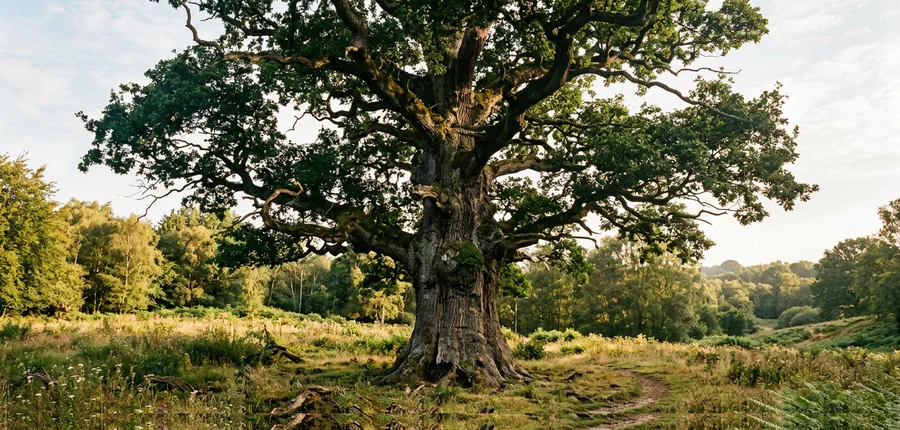
An ancient tree is one of genuinely great age — exceptional in its species context, with significant biodiversity value arising from the ageing process: wood decay, hollowing, the accumulation of habitat that only time can create. Very few trees of any species ever reach this stage.
A veteran tree may not be especially old, but it shows significant decay features — branch death, hollowing, deadwood — that give it comparable biodiversity, cultural, and heritage value. All ancient trees are also veteran trees, but a veteran tree is not necessarily ancient.
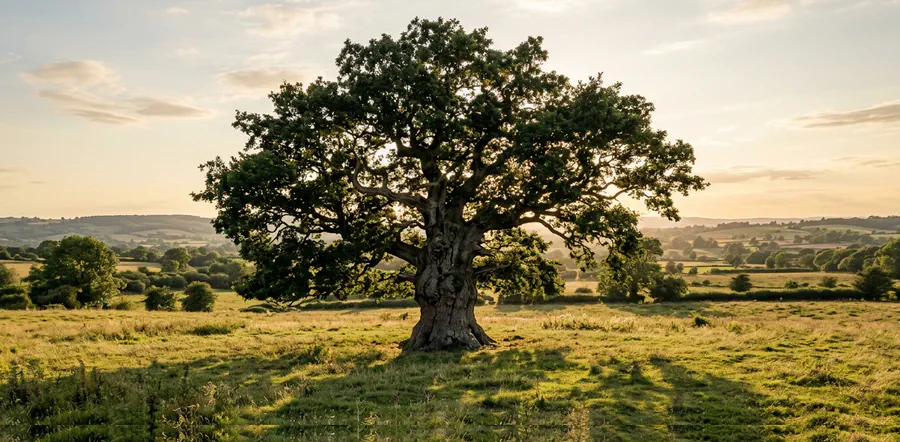
The age at which a tree becomes ancient or veteran varies by species, because different trees age at different rates. An oak with a girth of around 4.6 metres would be considered potentially veteran; a much smaller hawthorn of the same girth might qualify as ancient. The guidance recommends working from recognised species-specific criteria rather than applying a single size threshold across the board.
Ancient and veteran trees can exist anywhere — in hedgerows, orchards, parks, and fields, not just in woodland. If your site contains large old trees in any context, they may fall within this framework.
The planning position: what “irreplaceable” actually means
The word “irreplaceable” appears throughout this guidance, and it is not rhetorical. Ancient woodland and ancient and veteran trees are legally irreplaceable in the sense that no amount of new planting, habitat creation, or financial contribution can substitute for their loss.

Note the framing: a compensation strategy is a condition of granting consent in wholly exceptional circumstances, not a reason to grant it.
The guidance goes further on the question of condition. If a tree or woodland is in poor health, that is not grounds for permitting development. A woodland in poor condition can be improved with good management. Its existing state is irrelevant to whether the protection applies.
How development affects ancient woodland and veteran trees
The guidance draws a clear distinction between direct and indirect effects, and both are in scope.
Direct effects
Indirect effects
If your site is near ancient woodland or veteran trees, not just on top of them, indirect effects are still your problem to address.
Buffer zones: the numbers you need to know
Buffer zones are the practical mechanism for protecting ancient woodland and veteran trees during and after development. The guidance sets minimum standards, and these are non-negotiable starting points rather than targets to negotiate down from.
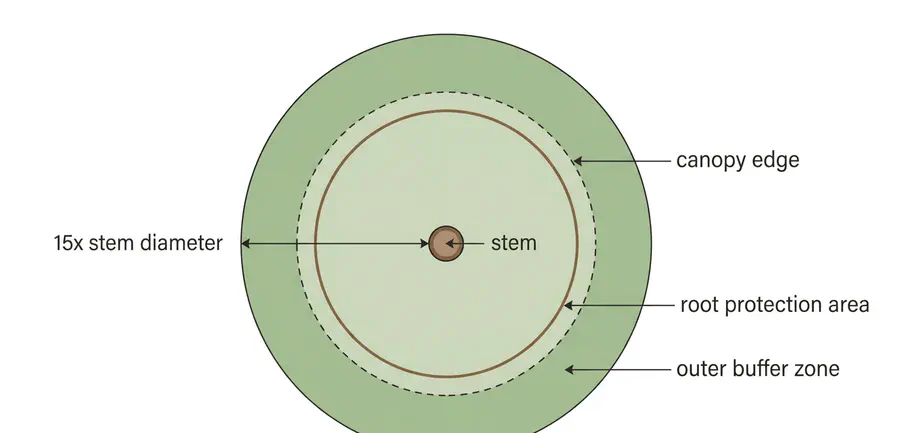
Ancient woodland: 15 metres from the boundary
Ancient and veteran trees: 15× stem diameter or 5m from canopy edge
Gardens and SuDS cannot substitute for buffer zones
What compensation looks like — and what it cannot do
Where development is granted consent in wholly exceptional circumstances, a compensation strategy is required. The guidance sets out what this can and cannot include.
Planting new trees is not a replacement for losing ancient woodland. New woodland creation can be accepted as one element of compensation, particularly where it links to and extends existing woodland. Soil translocation — moving soil from a destroyed area of ancient woodland — can be part of the approach, but it cannot recreate what has been lost. Moving an ancient woodland ecosystem is not possible.
Relocating individual veteran trees is not accepted as compensation. It may not be physically achievable and would break the tree’s connection to the ecosystem it depends on.
Compensation for the loss of veteran trees can include planting young trees of the same species with space to develop properly, combined with management of nearby veteran trees to prolong their lives. The hulk of any ancient or veteran tree that must be removed should be left in place — standing if possible — to continue providing habitat for invertebrates and fungi.
What to do before your application goes in
The practical implication of all of this is straightforward: find out what you are dealing with before you fix your scheme.
Check the inventories
Check the Ancient Woodland Inventory and the Woodland Trust’s Ancient Tree Inventory for your site and its surroundings before you fix your layout.Commission a BS5837 tree survey early
The survey should identify any trees with veteran characteristics. If veteran or ancient trees are present, establish their buffer zones and use that information to shape your layout — not the other way around.Engage an arboriculturist and ecologist before planning
Where ancient woodland or veteran trees are on or near your site, early engagement will establish what you can build, what needs to be avoided, and whether the scheme is viable in its current form. That conversation is substantially cheaper before planning than after.
Find out what's on your site before it becomes a problem.
Subito provides BS5837 tree surveys and arboricultural impact assessments for planning applications across England. If your site has old trees, we will identify them, assess them, and give you the information you need to design around them with confidence.