BS5837 Revision 2026: What's Changing and Why It Matters
The BS5837 revision is expected in 2026. Find out what's changing in tree survey methodology, RPA calculations, and what it means for live planning applications.
Why BS5837 Is Being Revised Now
BS5837, the British Standard that governs trees in relation to design, demolition, and construction, has been the backbone of arboricultural practice in the planning system since its last revision in 2012. Over a decade of application has exposed a number of persistent problems that the forthcoming revision is intended to address.
One of the most significant drivers is the inconsistency with which the standard has been applied across local planning authorities. Some LPAs have developed their own interpretations of tree categorisation, root protection area mapping, and the scope of arboricultural reports, leading to a situation where a submission acceptable in one authority may be rejected or conditioned in a neighbouring one. The revision process has drawn heavily on feedback from arboricultural consultants, LPA officers, and the Arboricultural Association to identify where the current standard is ambiguous or silent on matters that have since become routine points of dispute.
The Arboricultural Association’s updated guidance documents, published in the years since 2012, have also moved ahead of the standard in several areas, creating a gap between best practice and the formal benchmark that planning authorities reference. The revision is expected to bring the standard into closer alignment with current professional practice rather than leaving practitioners to bridge that gap informally.
Perhaps the most consequential external pressure comes from the Environment Act 2021 and the mandatory biodiversity net gain requirements that came into force for most developments in early 2024. Trees are a significant component of BNG assessments, and the current BS5837 framework was not designed with BNG in mind. The revision is expected to introduce clearer guidance on how tree survey data should interface with ecological assessment and BNG calculations, reflecting the reality that arboricultural and ecological work are now formally linked in the planning process in a way they were not when the 2012 standard was written.
Key Changes to Tree Survey and Assessment Methodology
While the final text of the revised standard has not yet been published, the direction of travel is reasonably clear from consultation outputs and AA working group communications. The most widely anticipated changes relate to how trees are categorised, how surveys are scoped, and what an Arboricultural Impact Assessment must contain.
The current four-category system — A, B, C, and U — is expected to be retained in broad terms, but with revised criteria for what qualifies a tree for each category. There has been consistent criticism that the current definitions allow too much subjectivity, particularly at the boundary between Category B and Category C, and that the criteria do not adequately account for a tree’s contribution to biodiversity or its role in the urban canopy. The revision is likely to introduce more explicit weighting for ecological value and canopy cover alongside the existing structural and amenity criteria.
The scope of what must be included in an Arboricultural Impact Assessment is also expected to expand. Under the current standard, AIAs focus primarily on physical impacts to trees during construction. The revised standard is anticipated to require consultants to address a broader range of impacts, including long-term management implications, the effect of proposed development on tree health over time, and the relationship between retained trees and proposed landscaping or green infrastructure.
Current BS5837 Category System
Survey methodology is also under review, with particular attention to the minimum information required at different stages of the design process. The current standard distinguishes between surveys carried out at the pre-application stage and those submitted with a planning application, but practitioners have found this distinction difficult to apply consistently. The revision may introduce clearer stage-based requirements tied more explicitly to RIBA design stages.
Changes to Root Protection Area Guidance
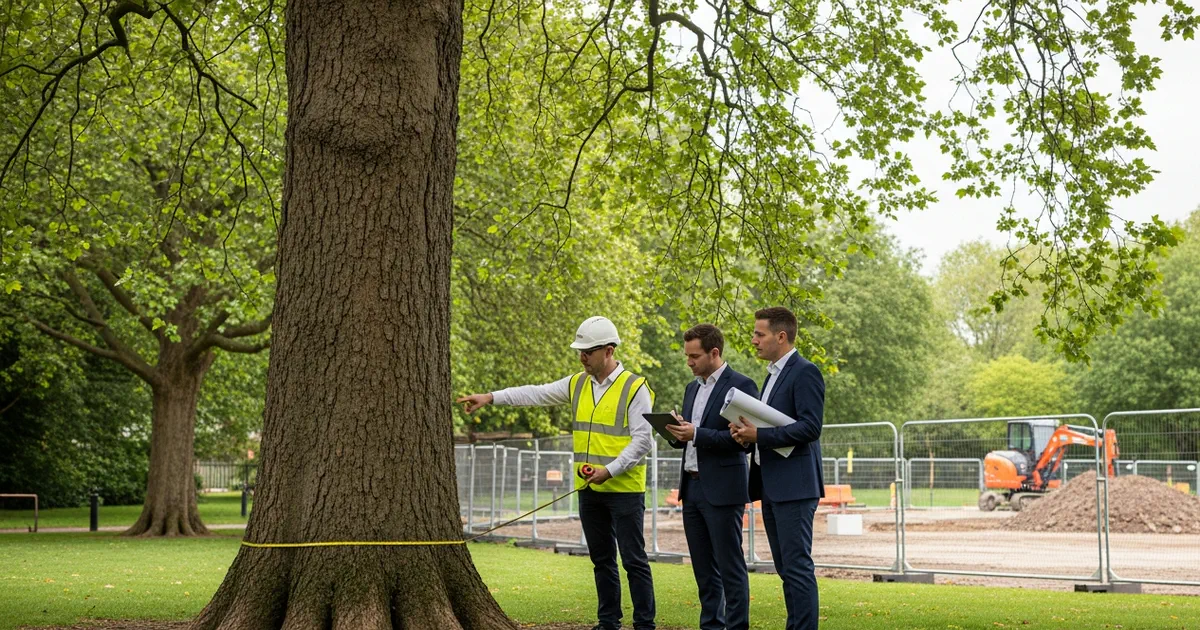
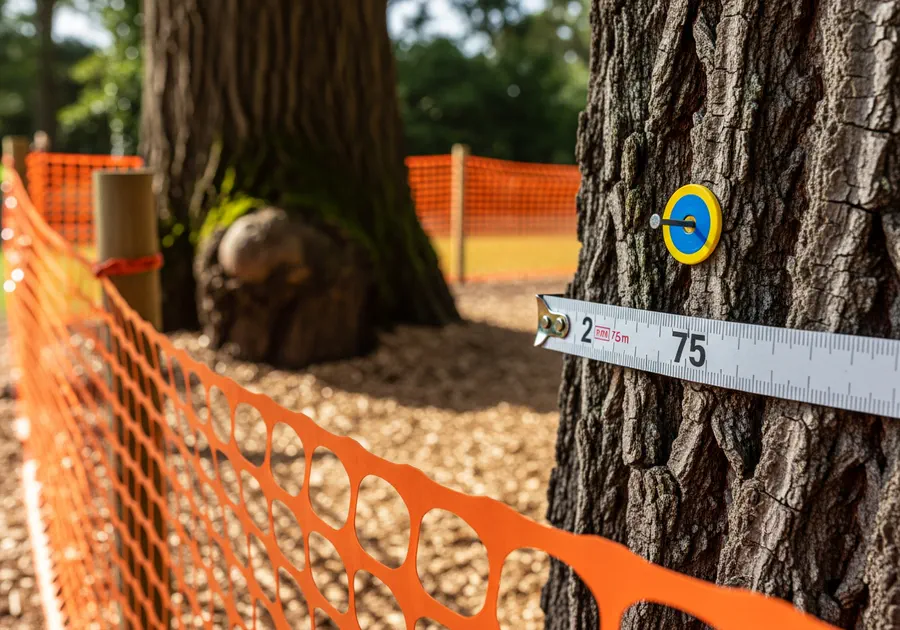
The root protection area calculation is one of the most practically significant elements of BS5837, and it is one of the areas where the revision is expected to introduce the most meaningful change. The current formula — based on stem diameter at breast height, with a minimum radius of five metres — has been widely criticised for producing RPAs that do not reflect the actual rooting characteristics of individual trees, particularly in urban environments where root spread is constrained by hard surfaces, services, and existing structures.
The revised standard is expected to move towards a more nuanced approach that allows for site-specific adjustment of RPA boundaries based on soil type, site history, and observable rooting evidence. This would represent a significant shift from the current prescriptive formula and would place greater responsibility on the surveying arboriculturalist to justify the RPA boundaries they map, rather than simply applying a calculation.
For infill and urban sites, this change could be genuinely liberating. Many urban trees have root systems that are effectively constrained well within the area the current formula would produce, and the inability to reflect this in a compliant survey has led to development proposals being constrained by theoretical RPAs that do not correspond to actual risk. A more flexible methodology, properly applied and documented, should allow for more accurate constraints mapping and reduce the frequency of unnecessary design compromises.
However, this flexibility will come with an obligation to demonstrate the basis for any departure from a standard calculation. LPAs are likely to scrutinise adjusted RPAs carefully, and consultants will need to ensure their survey records contain sufficient evidence to support the boundaries they present.
How the Revised Standard Affects Tree Constraints Plans and AIA Reports
The practical implications for report structure and drawing requirements are likely to be considerable. Tree Constraints Plans submitted under the current standard vary significantly in their content and presentation, partly because BS5837:2012 does not prescribe a detailed drawing format. The revision is expected to introduce more specific requirements for what a TCP must show, including how RPA boundaries are derived and how constraints interact with proposed development.
AIA reports are likely to face similar changes. The current standard provides a framework for what an AIA should address, but the level of detail required has been interpreted inconsistently. Under the revised standard, LPAs will have a clearer benchmark against which to assess submissions, which means that reports prepared to the current standard may be seen as deficient even if they were entirely compliant at the time of preparation.

Consultants preparing reports now should be aware that drawing conventions, report structure, and the level of supporting evidence expected by LPAs are likely to shift. Submissions that are technically compliant with the 2012 standard but do not anticipate the direction of the revision may attract conditions or requests for further information that could have been avoided with a more forward-looking approach.
What This Means for Applications Already in the Planning System
The transitional period around any standard revision is always a source of uncertainty for applicants and their consultants. The key question for live applications is whether arboricultural reports prepared under BS5837:2012 will remain acceptable once the revised standard is published.
In practice, LPAs are unlikely to reject applications solely on the basis that surveys were prepared under the previous standard, particularly where those surveys are recent and the application is well advanced. However, LPA tree officers will be aware of the revision and may use it as a basis for requesting additional information or imposing conditions where they feel the submitted material does not adequately address matters that the new standard would require. Applications that are at an early stage, or that have been in the system for some time without determination, carry a higher risk of being caught in this way.
For applications where arboricultural surveys are more than twelve months old, the question of whether to commission updated surveys is already live regardless of the revision. Where a survey refresh is needed anyway, it makes sense to prepare it in a way that anticipates the revised standard rather than simply replicating the approach of the original submission.
How Developers and Planning Consultants Should Prepare
The most effective response to an incoming standard revision is early engagement with your arboricultural consultant, before surveys are commissioned rather than after they have been submitted.
Review your programme
Identify which projects are likely to reach the planning application stage around or after the expected publication date of the revised standard. For these projects, discuss with your arboricultural consultant whether survey methodology should be aligned with the anticipated changes from the outset.Audit live submissions
For applications already in the planning system, ask your consultant to review submitted arboricultural reports against the known direction of the revision. Identify any areas where the current submission may fall short of what LPAs are likely to expect once the new standard is in force.Engage early on RPA implications
If your project involves constrained urban sites or infill development where RPA boundaries are a significant design constraint, discuss with your consultant whether the anticipated changes to RPA methodology could affect your constraints mapping. Early engagement can prevent design work proceeding on the basis of constraints that may be revised.Align arboricultural and ecological scopes
Given the expected closer integration of BS5837 with biodiversity net gain requirements, ensure that your arboricultural and ecological consultants are working from a shared brief. Surveys commissioned in isolation may need to be revisited if the two workstreams are not aligned from the start.
When briefing your arboricultural consultant, ask specifically how they are tracking the revision process, what changes they anticipate in their survey and reporting methodology, and whether their current approach already reflects the direction of the new standard. A consultant who is actively engaged with the revision process will be better placed to produce work that remains defensible through the transitional period and beyond.
What Subito Is Doing to Stay Ahead of the Revision
Subito has been monitoring the BS5837 revision process closely since the Arboricultural Association’s working group began its review. Our arboricultural staff maintain active engagement with AA guidance channels and participate in professional networks where emerging changes to the standard are discussed and tested against real project experience.
We have also been gathering feedback from LPA tree officers across the South East and East of England on the areas where they find current submissions most frequently deficient. This intelligence directly informs how we structure our reports and drawings, ensuring that our clients’ submissions are not only compliant with the current standard but are prepared in a way that anticipates the expectations of the revised one.
For clients with projects in the pipeline, we are already applying a forward-looking approach to survey methodology, RPA assessment, and AIA report structure. Where the anticipated changes to the standard are relevant to a specific project, we flag this proactively and advise on the most appropriate course of action rather than waiting for an LPA to raise concerns at validation or determination.
Frequently asked questions
Find out what's on your site before it becomes a problem.
Subito provides BS5837 tree surveys and arboricultural impact assessments for planning applications across England. If your site has old trees, we will identify them, assess them, and give you the information you need to design around them with confidence.