The BS5837 Revision: What's Changing and What It Means for Your Planning Application
The first revision of BS5837 since 2012 is on its way. Here is what developers, architects and homeowners need to know before it lands — and why it will affect tree surveys on almost every development site in England.
If you have ever applied for planning permission near trees, you have probably encountered the term BS5837. It is the British Standard that governs how trees are assessed, protected, and managed during design, demolition, and construction. It underpins almost every tree survey submitted to a Local Planning Authority in England.
The current version was published in 2012. A long-awaited revision has been in development since then, and a draft for public consultation was published in August 2024. Over 2,000 comments were submitted. The final version has not yet been published, but the direction of travel is clear — and the changes are significant enough that anyone planning a development should understand what is coming.
Here is what the revision proposes and what it is likely to mean for your project.
From recommendations to a Code of Practice
The biggest structural shift is one of legal weight. BS5837:2012 was framed as a set of recommendations. The revised standard moves to a formal Code of Practice.

For developers and architects, this means the survey you commission needs to be thorough from the outset. A lightweight or cut-price tree report is less likely to pass muster under the revised framework than it might have done previously.
New tree categories
The draft revision refines the way trees are categorised, and there are two changes worth knowing about.
Category U becomes Category X
A new Category V for veteran trees
Root Protection Areas are getting bigger
Root Protection Areas (RPAs) define the ground around a tree that must be protected during construction. Getting them right is critical. Incursions into RPAs through excavation, compaction, or heavy machinery are one of the most common causes of tree death on development sites.
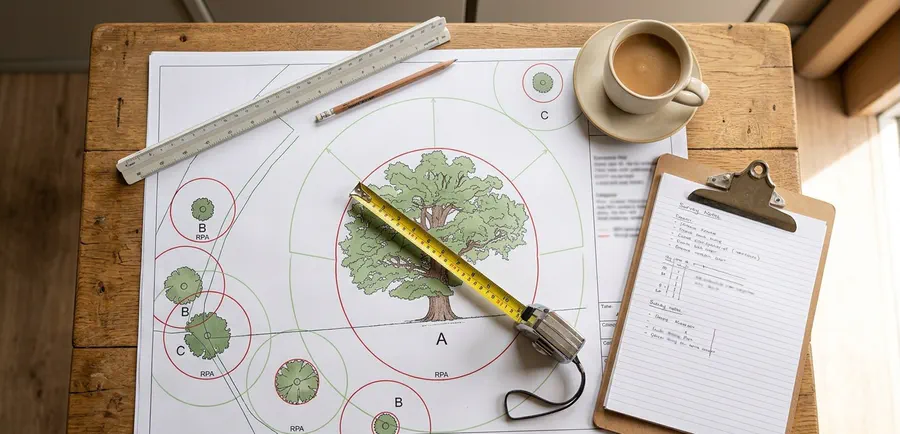
The revised standard makes three changes to how RPAs are calculated.
Stem diameter is measured lower on the trunk
Category A and V trees get a larger multiplier
A 1 metre buffer zone around every RPA
The practical effect for site designers is straightforward: trees will occupy more constrained space on your layout plan than they did before. Projects designed around the 2012 standard may need to revisit their tree protection arrangements when the revised version is published.
The Tree Constraints Plan becomes the ACOP
The familiar Tree Constraints Plan — the drawing that shows tree positions, canopy spreads, and RPAs on your site layout — will be renamed the Arboricultural Constraints and Opportunities Plan, or ACOP.
The name change is not cosmetic. It signals a shift in how the plan is meant to function. Rather than simply mapping constraints, the ACOP will be expected to identify where trees can be positively integrated into a development scheme. That means recording opportunities for new planting, canopy enhancement, and green infrastructure alongside the restrictions that trees impose.
The ACOP will also be required to show projected future canopy growth — not just the current crown spread of each tree. This is a meaningful new obligation. Arboricultural consultants will need to model how trees will grow over the coming decades and show how their expanding canopies interact with proposed buildings, access routes, and services. The intention is sound: preventing future conflicts between trees and infrastructure that could otherwise be avoided at the design stage. In practice, it will add time and cost to the assessment process.
The Arboricultural Impact Assessment gets a new name and a broader scope
Currently the key report submitted with a planning application is the Arboricultural Impact Assessment (AIA). Under the revised standard, this becomes the Arboricultural Impact Report (AIR).
The change of name reflects a more comprehensive approach. The AIR will be expected to assess both the positive and negative impacts of a proposed development on the tree population — not just the harm caused, but how a well-designed scheme might benefit trees or create new canopy cover. A structured annexe in the draft defines how the significance of impacts should be assessed, giving Tree Officers a clearer framework for evaluating reports.
A formalised hierarchy: avoid, mitigate, compensate
Canopy cover assessments become standard
Under the revised BS5837, canopy cover assessments will be required as standard across all development sites. This means every site survey will need to record the extent of existing canopy cover, assess how the proposed development affects it, and consider the age, diversity, and species composition of the tree population.
This is a significant addition. At present, canopy cover is considered on some sites but is not a universal requirement. Making it standard brings tree management closer to the approach taken in ecology, where site-wide habitat assessment is the baseline expectation.
What this means for your project right now
The revised BS5837 has not yet been published as a final standard. The consultation closed in October 2024, with the industry response generating over 2,000 comments. The final version is expected in due course, and further refinements are likely before it is issued.
However, the direction of travel is clear enough to plan for now.
Commission your tree survey before the standard is finalised
If you are at the early stages of a development project, act now. When planning officers begin applying the updated requirements, you risk having to revise survey documentation commissioned under the 2012 framework.Check your existing survey against the draft revision
If you are already in the planning process, make sure your arboricultural consultant is aware of the draft revision and can advise on whether your current survey documentation will hold up under the new framework.Build tree constraints into scheme design early
Changes to RPAs, canopy assessments, and the ACOP will affect layout and design constraints on virtually every development site that has trees. The earlier you build that into your scheme, the less disruption those constraints will cause.
Get a tree survey that keeps pace with the standard.
Subito provides BS5837 tree surveys and arboricultural impact assessments for planning applications across England. Our consultants follow the evolving standard closely and will ensure your survey documentation is robust, up to date, and fit for purpose with your Local Planning Authority.