BS5837 Survey Timeline: How Long Does It Take?
Find out how long a BS5837 tree survey takes from instruction to report, what each stage involves, and what causes delays on real development projects.
What the Question Actually Means
When developers and planning consultants ask how long a BS5837 survey takes, they usually mean one of two things. Either they want to know when they can submit their planning application, or they are trying to work out whether they have left it too late. Both are reasonable concerns, and the answer depends on more than just the arboriculturist turning up and writing a report.
The BS5837 process has several distinct stages, and each one takes time. Some of that time is within the consultant’s control. Some of it is not. Understanding where the time actually goes helps you plan your programme realistically rather than building in assumptions that fall apart when the survey comes back with complications.
The Stages That Make Up the Total Timeline
Initial Instruction and Mobilisation
Once you instruct an arboricultural consultant, there is a period before anyone sets foot on site. The consultant needs to review any existing information you can provide, such as site plans, title boundaries, and any previous survey work. They will also carry out desk study work, which typically includes checking aerial imagery, reviewing any relevant planning history, and identifying the likely scope of the survey before visiting.
For a straightforward residential or small commercial site, this preparation stage usually takes one to three days. For larger or more complex sites, particularly those with extensive tree cover or where the boundary is unclear, it may take longer. Mobilisation also depends on the consultant’s current workload and diary availability. During busy periods, particularly spring and early summer when survey demand peaks, you may be waiting a week or more before a site visit can be scheduled.
If you are working to a tight programme, it is worth contacting the consultant before you formally instruct them to check their current availability. A good consultant will tell you honestly whether they can meet your timeline.
The Site Visit
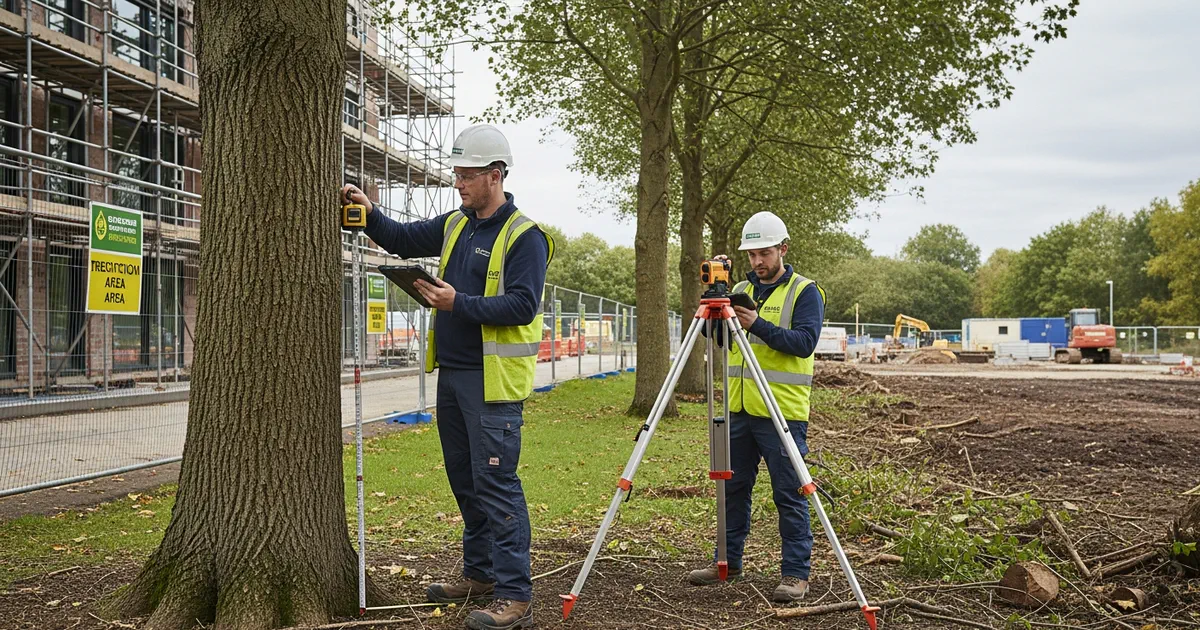
The site visit is the most visible part of the process, but it is not always the longest. For a small site with a handful of trees, a thorough survey can be completed in a few hours. For a large site with dense woodland, veteran trees, or complex boundaries, the survey may take a full day or spread across two visits.
During the visit, the arboriculturist records the data required under BS5837:2012 for each tree or group of trees. This includes species identification, stem diameter, height, crown spread, root protection area, condition, and preliminary category. They will also assess any constraints relevant to the proposed development, including trees on neighbouring land that fall within the root protection zones of the site.
The time on site is largely determined by the number of trees, the accessibility of the site, and whether any trees require closer inspection. Overgrown sites, steep terrain, or restricted access can all add time. If the site has not been cleared or is occupied, coordinating access can also introduce delays that have nothing to do with the survey itself.
Office Work: Processing Data and Producing the Report
This is the stage that is most often underestimated. After the site visit, the arboriculturist returns to the office with raw field data that needs to be processed, checked, and turned into a usable document. This involves calculating root protection areas, assigning final BS5837 categories, drafting the written report, and producing the tree survey schedule and constraints plan.
For a site with twenty to thirty trees, this office stage typically takes two to four days. For larger sites, or where the report needs to integrate with other documents such as an arboricultural impact assessment or method statement, it can take considerably longer. The constraints plan in particular requires accurate CAD or GIS work, and if the base plan you have provided is incomplete or at the wrong scale, that adds time to resolve.
Some consultants will provide a draft report for your review before issuing the final version. This is good practice and worth building into your programme, as it gives you the opportunity to flag any discrepancies before the document goes to the local planning authority.
Realistic Total Timescales
Pulling the stages together, a realistic end to end timeline for a BS5837 survey looks like this.
Small sites (under 15 trees)
Medium sites (30 to 60 trees)
For large or complex sites, including those with woodland, ancient or veteran trees, or multiple phases of development, six to ten weeks or more is not unusual. These surveys often require additional specialist input, extended desk study work, or multiple site visits to capture seasonal variation in canopy condition.
These are working timescales, not guarantees. They assume the consultant has capacity when you instruct them and that no significant issues arise during the survey.
What Causes Delays
Access and Site Conditions
Delayed or restricted access is one of the most common causes of a survey taking longer than expected. If the site is tenanted, occupied, or requires third party permission to enter, the arboriculturist cannot proceed until access is confirmed. This is entirely outside the consultant’s control, and it can add days or weeks to the programme depending on how quickly access is arranged.
Site conditions also matter. A site that has been recently cleared is much faster to survey than one with dense undergrowth or standing water. If trees are obscured or inaccessible, the arboriculturist may need to return once conditions improve.
Incomplete or Inaccurate Base Plans
The constraints plan produced as part of a BS5837 survey needs to be drawn onto an accurate site plan. If the plan you provide has errors, is missing boundary information, or does not reflect the current site layout, the arboriculturist will need to either request an updated plan or work around the discrepancy. Either option adds time. Providing a clean, scaled, and up to date base plan at the point of instruction is one of the simplest ways to avoid unnecessary delays.
Scope Changes During the Survey
Sometimes the scope of a survey changes once the arboriculturist is on site. Trees that were not visible on aerial imagery may be present. Neighbouring trees may fall within the site’s root protection zones and need to be included. A tree that appeared healthy from the boundary may show signs of significant decay that require additional assessment. These are not failures of planning, they are a normal part of the process, but they do add time.
If the scope changes materially, a good consultant will contact you to discuss the implications for the programme and the fee before proceeding.
Consultant Workload and Seasonal Demand
Arboricultural surveys follow seasonal patterns. Demand increases significantly in spring and early summer as development programmes accelerate and planning applications are submitted ahead of committee cycles. If you instruct a survey during a peak period without checking availability first, you may find that the earliest site visit slot is two or three weeks away, which pushes the entire timeline back before any work has started.

How to Build the Survey into Your Programme
The most practical approach is to treat the BS5837 survey as an early task rather than a late one. Instruct the survey as soon as the site boundary is confirmed and you have a base plan available. Do not wait until the design is complete, because the survey output should be informing the design, not chasing it.
Confirm site boundary and obtain base plan
Before instructing the survey, make sure you have a scaled, up to date site plan that accurately reflects the current boundary. This is the single most useful thing you can provide at the point of instruction.Contact the consultant to check availability
Do this before formally instructing, particularly during spring and summer. Confirm whether your target submission date is achievable given their current workload.Instruct the survey and confirm access arrangements
Arrange site access at the earliest opportunity. If the site is tenanted or requires third party permission, start that process immediately so it does not hold up the visit.Factor in time for AIA and TPP if required
If your project also requires an arboricultural impact assessment or tree protection plan, these documents depend on the BS5837 survey being complete and a draft layout being available. The full sequence from initial survey to a complete arboricultural submission can take eight to twelve weeks on a medium sized site, sometimes longer.
Communicate your planning submission target to the consultant at the point of instruction. A competent arboricultural consultant will tell you whether your timeline is achievable and flag any risks to it early, rather than letting you find out when the report is late.
Frequently asked questions
Find out what's on your site before it becomes a problem.
Subito provides BS5837 tree surveys and arboricultural impact assessments for planning applications across England. If your site has old trees, we will identify them, assess them, and give you the information you need to design around them with confidence.