Why Your BS5837 Tree Survey Gets Rejected at Validation (and How to Avoid It)
Why LPAs reject BS5837 tree surveys at validation — outdated reports, missing AIAs and TPPs, RPA errors, drawing standards, and how to submit a complete arboricultural package first time.
Your planning application is ready to submit. Then the local planning authority (LPA) comes back before they’ve even looked at the substance of it: your tree survey is invalid, and the application cannot be validated until you resubmit it.
It’s one of the most avoidable delays in the planning process. And it happens regularly, even on straightforward sites.
Here’s what causes it, and what a properly prepared survey looks like.
What validation actually means
Validation is the administrative check the LPA runs before your application enters the planning system. They are not yet assessing the merits of your proposal. They are checking that all required supporting documents are present and complete.
A BS5837 tree survey — the British Standard that governs how trees are assessed in relation to development — is a mandatory supporting document whenever trees are present on or near your site. If the LPA decides the survey does not meet the standard, they will not validate the application. The clock does not start. Nothing moves.
The frustrating thing is that validation rejection is almost never about the trees themselves. It is about how the survey was prepared and presented.
The most common reasons for rejection
The survey is out of date
BS5837 does not specify a hard expiry date, but most LPAs will not accept a survey that is more than two or three years old. Some will reject anything older than 12 months if the site has changed or if tree condition is likely to have shifted. If you are reusing a survey from a previous planning attempt or an earlier feasibility stage, check the date before you submit.
The arboricultural impact assessment is missing
A tree survey produces a schedule of trees — their species, dimensions, and quality classification. That is the starting point, not the finish line. If your development affects those trees, you also need an arboricultural impact assessment (AIA): a document that specifically analyses the relationship between your proposed works and each tree. Many applications arrive with the survey but not the AIA. The LPA will not accept one without the other on any site where impact is foreseeable.
The tree protection plan is not included
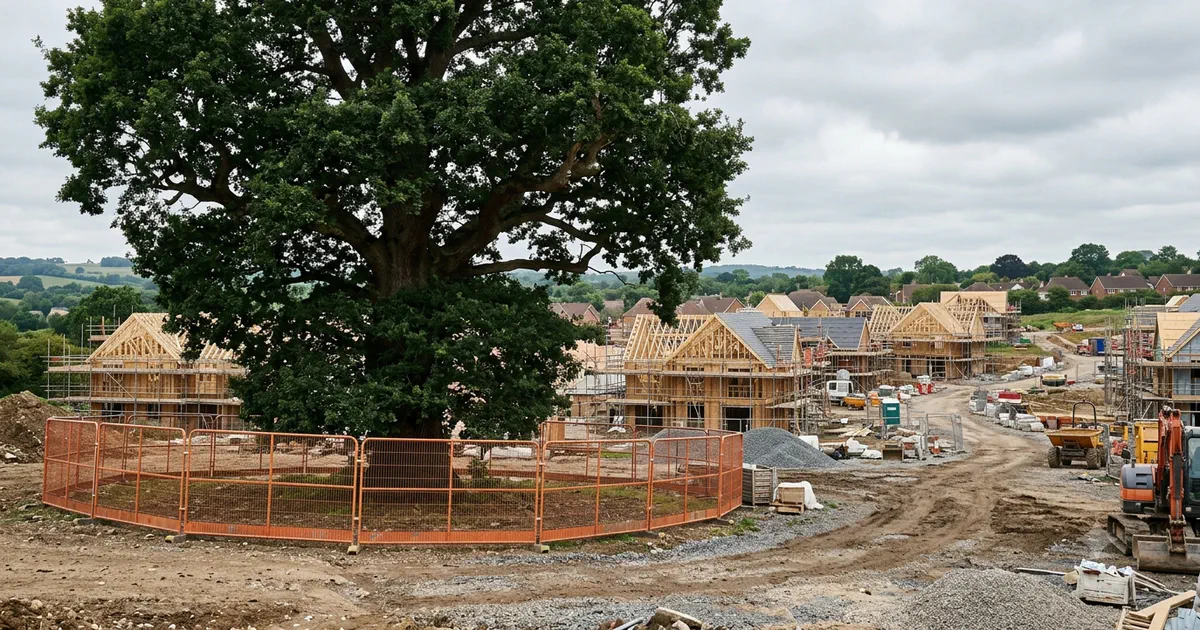
Once an AIA has established that trees can be retained, the LPA needs to know how you will protect them during construction. That is the role of a tree protection plan (TPP): a drawing that shows the location and specification of protective fencing and ground protection around retained trees. Submitting a survey and an AIA without a TPP is another common gap that stops applications at the door.
The root protection areas are calculated incorrectly
The root protection area (RPA) is the zone around a tree within which ground disturbance should be avoided. It is calculated using a formula set out in BS5837, based on the measured stem diameter of the tree. Errors here — whether from incorrect measurements or outdated methodology — are picked up by tree officers. If the RPA has been underestimated, the protection proposals built around it will be rejected on the same grounds.
The drawings are not to scale or lack key information
Planning drawings follow strict conventions. Tree survey plans need to show north point, scale bar, site boundary, all surveyed trees tagged to the schedule, and RPAs drawn accurately. Missing any of these is enough to trigger rejection. Some LPAs also require the drawings to be geo-referenced or submitted in a specific file format — check the validation checklist for the specific authority before you submit.
The surveyor is not suitably qualified
Some LPAs now check that the signatory on the report holds a recognised arboricultural qualification — typically membership of the Arboricultural Association or a relevant degree or diploma in arboriculture. A survey signed off by someone who cannot demonstrate that they meet this threshold can be rejected on qualification grounds alone.
What a complete BS5837 submission looks like
A correctly prepared submission for a development site where trees are present will typically include:
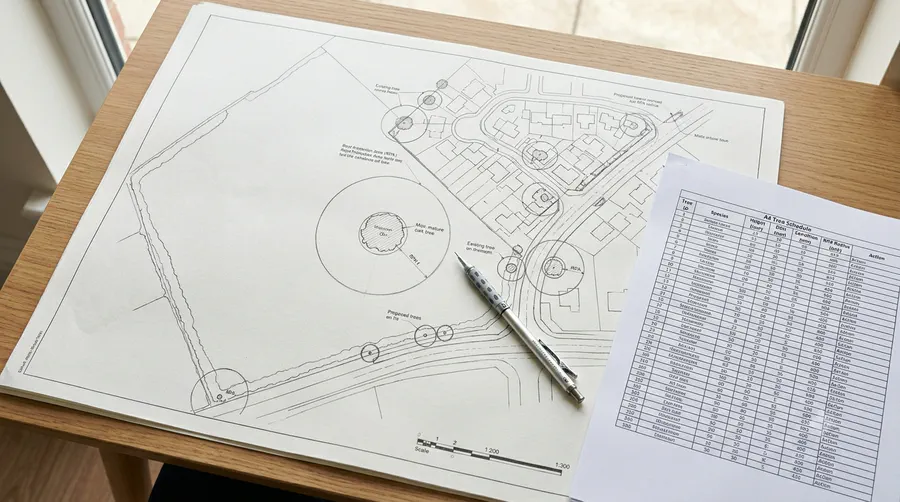
- A tree survey schedule with species, stem diameter, height, crown spread, and BS5837 quality category for every surveyed tree
- A tree survey plan showing all surveyed trees, their RPAs, and the site boundary
- An arboricultural impact assessment setting out the relationship between the proposed development and each tree
- A tree protection plan showing protective measures for all retained trees
- An arboricultural method statement if any works are proposed within RPAs
The method statement is sometimes prepared separately as a planning condition rather than at submission stage — but if you know works within RPAs are unavoidable, including it up front can prevent a condition that delays your start on site.
How to avoid the delay entirely
Commission the survey early, before you finalise your site layout. This is the single most effective step you can take. An arboriculturist can advise on which trees are likely to be retained or removed, and your architect can design around that information rather than retrofitting it later.
Brief your consultant clearly on the LPA you are submitting to. Different authorities have different local requirements layered on top of the standard, and a consultant who knows the area will flag these before submission rather than after rejection.
Check the LPA’s validation checklist before you submit. Most authorities publish these online. The checklist will tell you exactly which documents are required and any format or scale requirements that apply.
Get it right the first time
Subito prepares BS5837 tree surveys, arboricultural impact assessments, tree protection plans, and method statements for developers and housebuilders across the South East and East of England.
Our reports are written to be validated. We know what tree officers look for and we prepare our submissions accordingly.
Get a quote for your site today.
Enter your site postcode and project details for a fixed, itemised quote — BS5837 surveys, AIAs, tree protection plans and method statements scoped to your LPA's requirements.