Discharging a Tree Planning Condition: What Evidence Councils Want
Find out exactly what evidence councils expect when discharging a tree planning condition, so you can avoid delays and get approval first time.
Why Discharging a Tree Condition Is Not a Formality
Planning consent does not mean you can start work. If your permission includes a tree condition, you need formal approval from the local planning authority before that condition is discharged. Many applicants treat this as a box-ticking exercise and submit minimal information. Councils reject those submissions or come back with lengthy information requests, which delays the start on site.
The condition exists because the authority identified trees worth protecting during the planning process. When you apply to discharge it, you are demonstrating that the protection measures are adequate and that the development as built will not compromise those trees. The evidence you submit needs to make that case clearly and completely.
What the Condition Wording Actually Requires
Before preparing any submission, read the condition text carefully. Tree conditions vary significantly. Some require approval of an arboricultural method statement before development begins. Others require details of tree protection fencing, ground protection, or a watching brief during groundworks. Some conditions are phased, requiring sign-off at multiple stages rather than just at the start.
The condition will usually reference a specific document, such as the tree survey submitted with the application, or it will describe the category of information required. If the condition references a document that has since been superseded by design changes, you need to address that discrepancy in your submission. Submitting a method statement that does not align with the current site layout is one of the most common reasons for refusal at this stage.
If the wording is ambiguous, contact the case officer before submitting. A short pre-submission conversation can save weeks.
The Core Documents Councils Expect
Arboricultural Impact Assessment
If an arboricultural impact assessment was not submitted at application stage, or if the design has changed materially since the original assessment, you will need one now. This document identifies which trees are affected by the development, assesses the likely impact on their root protection areas and canopy, and sets out whether those impacts are acceptable.
The assessment needs to be based on the current planning drawings, not an earlier iteration. Councils will cross-reference the assessment against the approved plans. If the building footprint, access route, or drainage layout has shifted since the original survey, the assessment must reflect the current position.
Arboricultural Method Statement
This is the document most commonly required by tree conditions and the one where submissions most often fall short. The method statement sets out precisely how construction activity will be managed to protect retained trees throughout the build.
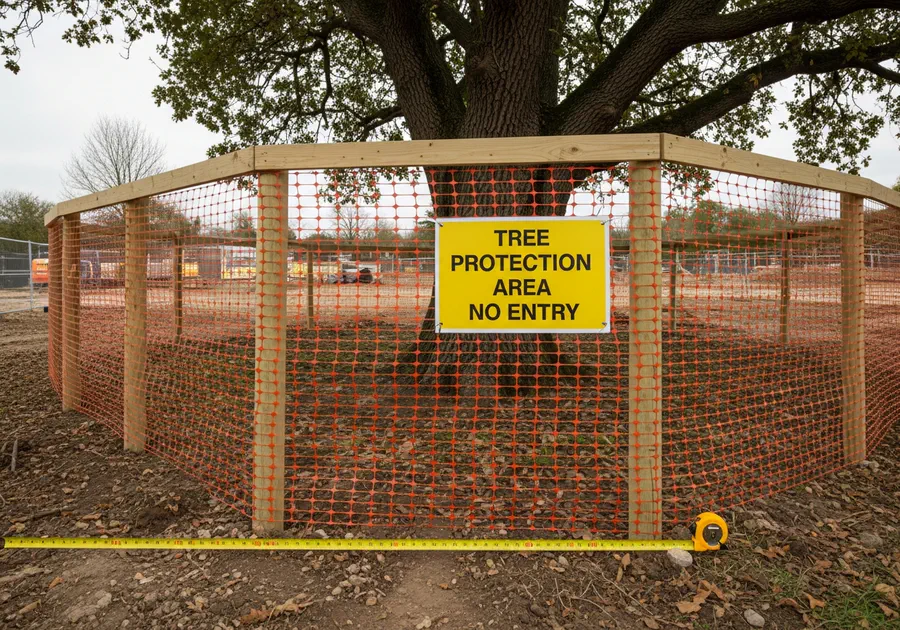
Councils want to see specific detail, not generic commitments. The statement should cover the location and specification of tree protection fencing, including the type of fencing, the exact positions relative to individual trees or groups, and when it will be erected and inspected. It should describe any ground protection measures required within root protection areas, such as no-dig surfaces, scaffold boards, or proprietary systems, and explain why those measures are appropriate for the ground conditions and the works proposed.
It should also address services and drainage routes. If any trenches, drainage runs, or service connections pass near retained trees, the method statement needs to explain how those works will be carried out, whether by hand, by air spade, or by directional drilling, and at what depth. Vague references to avoiding tree roots are not sufficient.
If a watching brief by an arboriculturalist is required during any phase of groundworks, the method statement should confirm who will carry it out, at what intervals, and what the reporting arrangements are.
Tree Protection Plan
The tree protection plan is a scaled drawing that shows the position of all retained trees, their root protection areas calculated in accordance with BS 5837:2012, and the proposed tree protection measures overlaid on the current site layout. It needs to be drawn to a scale that allows the council to verify distances and check that protection fencing is positioned correctly.
BS 5837:2012 Root Protection Area
The plan should be consistent with the method statement. If the method statement describes fencing at the edge of the root protection area but the plan shows it positioned differently, the submission will generate queries. Both documents need to tell the same story.
Some councils also want the tree protection plan to show the location of any proposed ground protection, service routes, and areas where construction exclusion zones apply. Check the condition wording and any pre-application advice to see whether this level of detail is expected.
Confirmation of the Supervising Arboriculturalist
Where the condition or the method statement requires site supervision by an arboriculturalist, councils increasingly want to see confirmation of who that person is before they discharge the condition. This means providing the name and qualifications of the supervising arboriculturalist, along with a brief description of their role and the stages at which they will attend site.
This is not always explicitly stated in the condition, but providing it proactively demonstrates that the supervision arrangements are real rather than theoretical. It also gives the council a named contact if they want to follow up during construction.
How Councils Assess the Submission
Most councils refer tree condition discharge applications to their tree officer or an appointed arboricultural consultant. That person will check whether the submitted documents are technically sound and whether they are consistent with each other and with the approved plans.
They will look at whether the root protection areas have been calculated correctly, whether the fencing specification is appropriate for the tree species and size, and whether the method statement addresses all the construction activities that could affect retained trees. They will also check whether the documents are based on a current site survey or whether they appear to have been produced without a site visit.
If the submission is thin or generic, the tree officer will either recommend refusal or issue a request for further information. Either outcome delays the discharge and delays the start on site. A thorough submission that anticipates the tree officer’s questions is always faster.
Common Reasons Submissions Are Rejected or Queried
The most frequent problems are documents that do not reflect the current design, method statements that describe protection measures in general terms without specifying locations or specifications, tree protection plans drawn at a scale that makes it impossible to verify distances, and submissions that ignore services and drainage entirely.
Another common issue is submitting documents prepared by someone without relevant qualifications or experience. Councils are entitled to question the competence of the author, and a method statement prepared by someone without arboricultural credentials will attract scrutiny.
Using outdated survey data is also a recurring problem. If the original tree survey was carried out more than a year before the discharge application, or if there have been changes to the trees since the survey, the council may require an updated survey before they will consider the method statement.
Timing and the Pre-Commencement Requirement

Submit the discharge application as early as possible. The statutory determination period for a discharge of condition application is eight weeks, though many councils take longer. If you are working to a programme, factor in the possibility of a request for further information, which resets the clock.
If the condition is phased, make sure you understand which phase requires approval before which activity. A condition that requires approval of a watching brief arrangement before groundworks begin is different from one that requires a full method statement before any development commences. Read the condition carefully and if necessary get written confirmation from the case officer about what is required at each stage.
What to Submit and How to Present It
Use the correct form
Submit the application through the Planning Portal using the discharge of condition form. Reference the condition number clearly in the covering letter or application form so there is no ambiguity about which condition you are seeking to discharge.List every document
Include a schedule of all submitted documents in your covering letter and explain how each one satisfies the requirements of the condition. This makes the tree officer’s job easier and reduces the chance of a query based on a misunderstanding about what has been provided.Address any gaps or discrepancies
If there are aspects of the condition that you believe are not applicable to the current scheme, explain why in the covering letter rather than simply omitting the information. Silence on a point the condition raises will prompt a query.Include author qualifications
Include the qualifications of the arboriculturalist who prepared the documents. This is not required by every council, but it is good practice and it addresses one of the most common grounds for querying a submission before it has even been assessed on its merits.
Frequently asked questions
Find out what's on your site before it becomes a problem.
Subito provides BS5837 tree surveys and arboricultural impact assessments for planning applications across England. If your site has old trees, we will identify them, assess them, and give you the information you need to design around them with confidence.