Further Information Requested on a Tree Planning Condition
Find out what a further information request on a tree planning condition means, why it happens, and what you need to submit to move forward.
What the Notice Actually Means
When a local planning authority issues a notice saying further information is requested on a tree planning condition, it means the condition attached to your planning permission has not yet been discharged. The authority has reviewed what you submitted and decided it is not sufficient to allow them to formally approve it. Work cannot lawfully begin on the parts of the site affected by that condition until the matter is resolved.
This is not a refusal. It is a request for additional or improved information before a decision can be made. The distinction matters because some applicants treat it as a setback when it is actually a defined procedural step. The condition remains live, and you still have the opportunity to satisfy it.
The notice will usually come through the planning portal or by letter, and it will reference the specific condition number from your permission. It may include a short explanation of what is missing or inadequate, though the level of detail in these notices varies considerably between authorities.
Common Reasons a Tree Condition Triggers a Further Information Request
Tree conditions are among the most frequently disputed at the discharge stage. Authorities attach them to protect trees during construction, and they expect the submitted information to demonstrate clearly that the protection measures are adequate and properly thought through.
The most common reason for a further information request is that the arboricultural method statement or tree protection plan submitted does not meet the requirements of BS 5837:2012. This British Standard sets out how tree surveys, impact assessments, and protection measures should be carried out and presented. If the document references an outdated survey, omits required sections, or uses protection layouts that do not reflect the actual construction programme, the authority will ask for more.
Another frequent cause is a mismatch between the tree survey data and the proposed development layout. If the root protection areas shown on the tree protection plan do not align with the current planning drawings, or if the survey predates significant design changes, the submitted information will not hold up to scrutiny.
Some authorities also request further information when the arboricultural impact assessment does not adequately justify the loss of or encroachment into trees categorised as B or A quality under BS 5837. If the assessment simply states that impacts are acceptable without explaining the reasoning, that is often not enough.
Finally, if the condition requires a watching brief or site monitoring and the submission does not name a qualified arboricultural consultant to carry out that role, or does not set out how and when they will attend site, the authority will ask for clarification.
What You Need to Submit in Response
The response to a further information request needs to directly address whatever the authority has identified as insufficient. Generic resubmissions that do not engage with the specific points raised will result in another request or an outright refusal to discharge the condition.
If the issue is with the arboricultural method statement, the revised document needs to set out clearly how each phase of construction will be managed in relation to the retained trees. This includes groundworks, drainage runs, service installations, material storage, and vehicle access routes. It should be written by a qualified arboriculturalist and cross referenced to the tree protection plan.
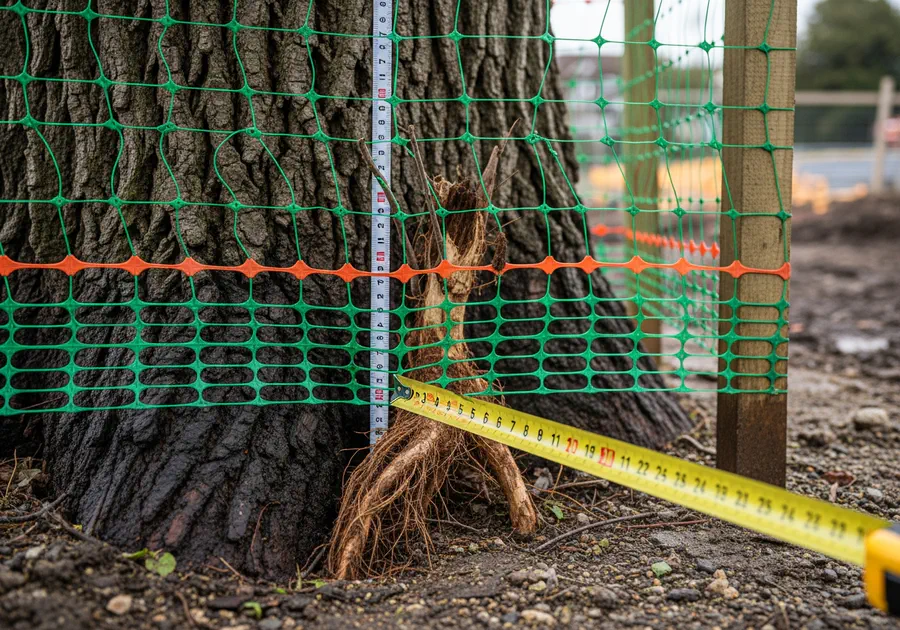
If the tree protection plan is the problem, it needs to be redrawn to reflect the current approved site layout. Root protection areas must be calculated correctly using the methodology in BS 5837, and the protection barrier positions must be shown accurately. The plan should be at a scale that allows the authority to read it clearly, and it should include a legend and north point.
BS 5837:2012 Root Protection Area
Where the authority has questioned the arboricultural impact assessment, the response should provide a more detailed justification for any encroachment into root protection areas or canopy spread. If no impact methodology such as air spading or no dig construction is proposed, the assessment should explain why and what alternative approach is being taken.
If the condition requires an arboricultural watching brief, the submission should confirm who will carry it out, what their qualifications are, how frequently they will attend, and how they will report back to the authority. Some authorities want a draft monitoring report template included at this stage.
How Long the Process Takes
Once you submit a response to a further information request, the authority has a set period to make a decision on the discharge of condition application. In England, the statutory period is eight weeks for most applications, though this can vary depending on the complexity of the condition and the authority’s workload.
Statutory Decision Period
In practice, many authorities take longer than eight weeks, particularly where tree officers are shared across multiple districts or where the application is complex. If you are working to a construction programme, it is worth contacting the case officer early to understand their expected timeline and whether there is any scope to agree a faster turnaround.
If the authority fails to make a decision within the statutory period and you have not agreed an extension of time, you have the right to appeal the non determination. This is rarely the most efficient route, but it is available if the delay is causing serious programme problems.
What Happens if the Condition Is Not Discharged Before Work Starts

This applies even if you believe the work in question does not directly affect the trees. The condition exists to protect trees throughout the construction process, and the authority takes the view that protection measures must be in place before any activity begins.
If a breach occurs, the authority can issue an enforcement notice requiring you to stop work and potentially to remedy any damage caused. Beyond the legal risk, a breach of a tree condition can complicate the sale or refinancing of a development. Solicitors acting for purchasers or lenders will identify an undischarged condition and will want evidence that it has been resolved before proceeding. If a breach has occurred, you may also need to apply for a lawful development certificate or retrospective planning permission, which adds time and cost.
The straightforward position is that the condition needs to be discharged before the relevant work starts, and the further information request is the step that is currently preventing that from happening.
Getting the Resubmission Right
The most effective way to respond to a further information request is to obtain a clear written explanation from the case officer or tree officer about exactly what they need. Planning portals do not always provide enough detail in the notice itself, and a short phone call or email exchange can save significant time.
Once you know what is required, the resubmission should be prepared by a qualified arboriculturalist who understands both the technical requirements of BS 5837 and the specific expectations of the authority in question. Different authorities have different preferences for how documents are structured and what level of detail they expect, and experience of working with a particular authority is genuinely useful at this stage.
Get the detail in writing
Contact the case officer or tree officer directly to obtain a clear written explanation of what the further information request requires. Do not rely solely on the portal notice, which often lacks the specificity needed to prepare an adequate response.Assess whether the original survey is still valid
Check whether the existing tree survey is current and reflects the approved design. If the survey is more than a few years old or predates significant layout changes, commission a fresh survey rather than attempting to patch the existing document.Prepare the revised documents
Have a qualified arboriculturalist prepare or revise the arboricultural method statement, tree protection plan, and arboricultural impact assessment to address each point raised. Ensure all documents cross reference one another and align with the current approved drawings.Submit with a covering letter
Accompany the resubmission with a covering letter that sets out point by point how each issue identified in the further information request has been addressed. This makes it easier for the case officer to process the application and reduces the likelihood of a second request.
If the original survey is more than a few years old or predates significant design changes, it is worth considering whether a fresh survey is needed rather than attempting to update the existing one. An outdated survey that has been amended piecemeal is often harder to defend than a clean document prepared against the current site layout and design.
Frequently asked questions
Find out what's on your site before it becomes a problem.
Subito provides BS5837 tree surveys and arboricultural impact assessments for planning applications across England. If your site has old trees, we will identify them, assess them, and give you the information you need to design around them with confidence.