Planning Permission When Trees Are Removed Before a Survey
Removed trees before a BS5837 survey was done? This creates serious problems for your planning application. Find out what LPAs assume and how to recover.
The Problem: Trees Removed Before a Survey
It is a situation we encounter more often than you might expect. A client acquires a site for development and, in an effort to prepare it, clears vegetation including a number of trees. The instruction to carry out a BS 5837 tree survey for the planning application comes after the trees are already gone. This action, whether intentional or not, creates an immediate and significant challenge for the planning process. The absence of the trees means there is no baseline data. We cannot assess their quality, their size, their species, or their potential contribution to local character and biodiversity. This information vacuum places the entire project on the back foot from the very beginning. The local planning authority is deprived of the information it needs to make a proper assessment, and the project team is left trying to justify a development proposal against a set of unknown constraints.
Why this happens
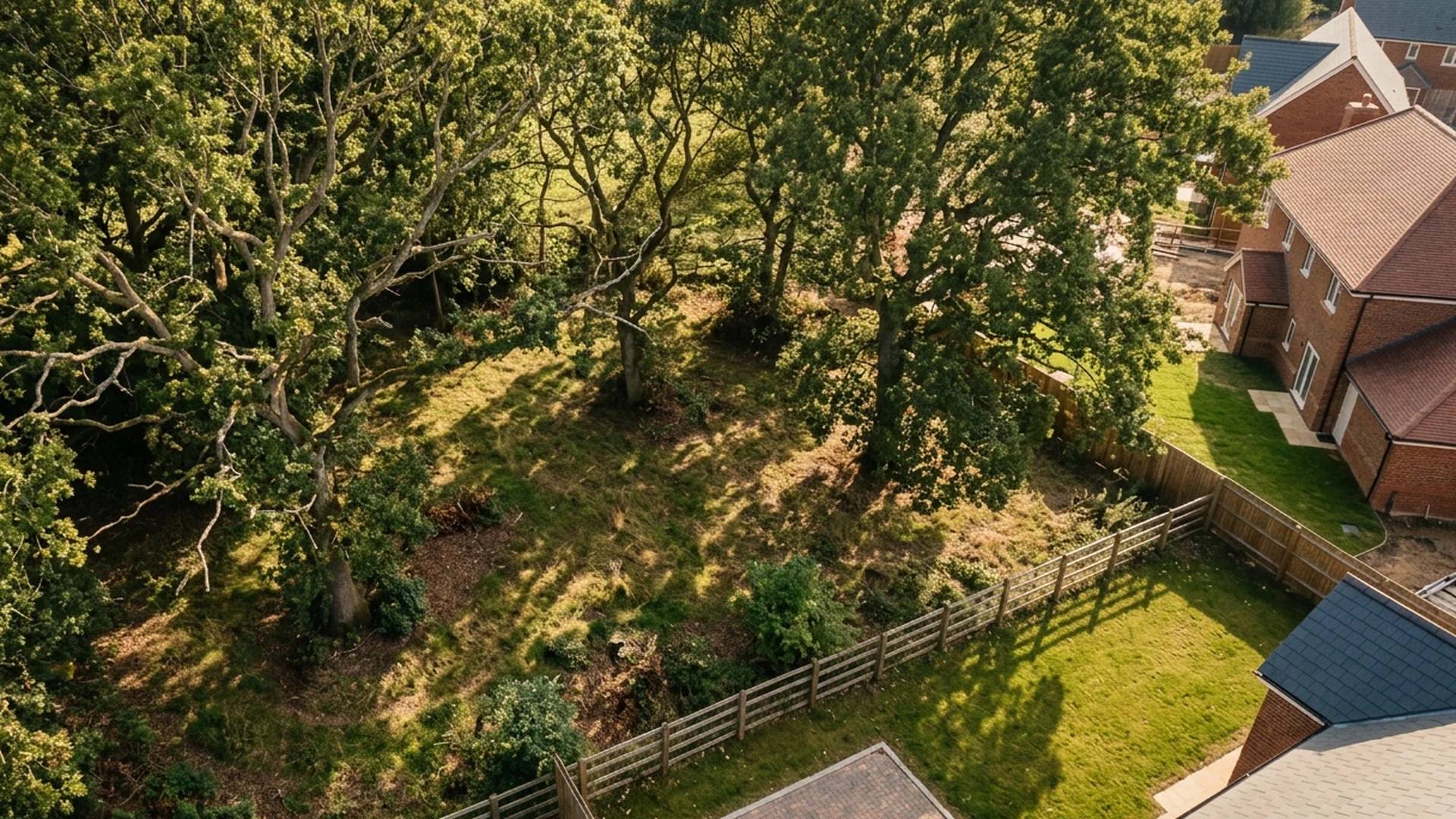
There are several common reasons for the premature removal of trees. Often, it stems from a simple misunderstanding of the planning process. A developer might assume that since they own the land, they are free to manage the vegetation as they see fit prior to submitting an application. They may see clearance as a practical first step, tidying the site to better visualise its potential. In other cases, it is a misguided attempt to simplify the development process. The thinking is that if the trees are not there, they cannot be a constraint. This approach fundamentally misinterprets the role of arboricultural assessment in planning. It is not about the trees present on the day of the survey, but about the site’s arboricultural character and value before the proposed development. Sometimes the removal is carried out by a previous landowner, and the new owner inherits the problem. Regardless of the reason, the consequence is the same: a complicated planning application with a high degree of uncertainty.
The local authority’s perspective
From the perspective of a local planning authority and its Tree Officer, the preemptive removal of trees is an immediate red flag. Their default position will be one of suspicion. They will likely assume the removal was a deliberate act to circumvent planning policy and eliminate a potential constraint on the development. Their working assumption will be that the removed trees were of high quality and value. They have a duty to protect the area’s green infrastructure and cannot simply ignore the fact that trees were present. The absence of a survey means they have no evidence to the contrary, so they must adopt a precautionary and often worst-case approach. This creates an adversarial starting point. Instead of a collaborative process to design a scheme around existing constraints, the conversation becomes about justifying the loss of assets that can no longer be properly assessed. This immediately erodes trust and makes securing planning permission significantly more difficult.
How Preemptive Tree Removal Affects Your Planning Application
The removal of trees before a survey is not a minor procedural issue. It has direct, tangible impacts on the planning application, affecting everything from the data you can submit to the ultimate developable area of the site. It introduces a level of ambiguity that planning authorities are inherently uncomfortable with, leading to delays, costly redesigns, and an increased risk of refusal.
Loss of arboricultural data
The foundation of any arboricultural impact assessment is the tree survey, which gathers precise data according to British Standard 5837. This includes species, stem diameter, height, crown spread, age class, physiological condition, and structural condition of every significant tree on site. This data is used to calculate the root protection area, a critical constraint for site layout, and to assign each tree a retention category. When trees are removed, all this data is lost permanently. We cannot accurately measure a tree that is no longer there. We are left with stumps, which can give an indication of diameter and possibly species, but provide no information on height, spread, or condition. This lack of data makes it impossible to produce a compliant BS 5837 survey for the entire site as it was. Any report submitted will carry a significant caveat, immediately weakening its authority and the credibility of the application.
Assumptions the LPA will make
In the absence of concrete data, the LPA must make assumptions, and those assumptions will not be in the developer’s favour. The Tree Officer will likely classify the removed trees as healthy, mature specimens of high amenity value.
LPA default classification
Consequently, the authority will assume large root protection areas that would have constrained the layout, as well as a significant loss of canopy cover and biodiversity value. This is an extremely difficult, if not impossible, position to argue from without evidence. The LPA is justified in taking this stance because their primary role is to protect public amenity, and they cannot allow the destruction of potential assets to go unchallenged. This defensive posture shapes all subsequent negotiations and sets the tone for every technical exchange that follows.
The impact on your site’s potential
The practical outcome of these negative assumptions is a direct reduction in your site’s development potential. The LPA may require the developable area to be reduced to reflect the root protection areas of the trees that were removed. They will almost certainly impose demanding and costly mitigation planting requirements. This will not be a simple one-for-one replacement. The requirement could be for multiple large-stock trees to replace each one lost, which can significantly constrain usable space and add considerable expense to the scheme. In some cases, the assumed constraints of the removed trees can be so significant that the proposed scheme becomes unviable. The layout you had planned may be impossible to achieve, forcing a complete redesign with increased professional fees and delays that erode the project’s profitability before it has even begun.
What Happens if You Remove Trees Without Permission
Beyond the immediate planning application problems, removing trees without checking their legal status can lead to serious legal consequences. The assumption that you can do as you wish on your own land is incorrect. Certain trees are legally protected, and their unauthorised removal constitutes a criminal offence.
When you need permission to remove trees
There are two primary forms of legal protection for trees in England that developers must be aware of. The first is a Tree Preservation Order. A TPO is made by an LPA to protect specific trees, groups of trees, or woodlands in the interests of amenity. It is illegal to cut down, uproot, top, lop, wilfully damage, or wilfully destroy a protected tree without the planning authority’s written consent. The second form of protection applies to trees within a Conservation Area.
Conservation Area tree threshold
Felling a protected tree without the required consent is a serious matter that exposes the landowner to criminal prosecution, regardless of whether a planning application is subsequently submitted.
Potential penalties and enforcement action

Cases are heard in the Magistrates’ Court or Crown Court depending on the seriousness of the offence. In addition to any financial penalty, the landowner becomes subject to a legal duty to plant replacement trees. The LPA can serve a Tree Replacement Notice specifying the number, species, size, and position of the new trees, and failure to comply with that notice is a further offence. This enforcement action runs entirely parallel to any difficulties you may be encountering with a planning application, compounding the project’s problems at every level and creating reputational as well as financial risk.
Our Approach: How We Handle Sites With Missing Trees
When faced with a site where trees have been removed, our role is to mitigate the damage and build a credible case for the planning application. It is a difficult situation, but not always an impossible one. Our approach is methodical and evidence-based, focusing on reconstructing what was there and negotiating a pragmatic way forward with the local authority.
Reconstructing the baseline
Our first task is to carry out forensic arboricultural work to reconstruct the baseline conditions as accurately as possible. We cannot invent data, but we can use available evidence to build a picture of what was lost. We examine the remaining stumps to determine their diameter and, where possible, identify the species. We analyse high-resolution historical aerial photography, current aerial imagery, and resources such as Google Street View to assess the former height, crown spread, and location of the trees. We also look for ecological indicators on site that might suggest the type of tree cover that existed. This information is compiled into a report that, while not a compliant BS 5837 survey, provides a reasoned and evidence-based estimate of the site’s previous arboricultural character. It replaces assumption with information, and that distinction matters enormously when engaging with the planning authority.
Negotiating with the Tree Officer
With a reconstructed baseline, we can engage with the LPA’s Tree Officer from a more informed position. Our approach is to be transparent about the situation from the outset. We present our findings and methodology clearly, acknowledging the breach in process while providing the best available technical evidence. The goal is to shift the conversation away from a punitive stance and towards a practical discussion about mitigation. By providing a credible, albeit incomplete, assessment, we give the Tree Officer a basis for negotiation rather than leaving them to fill the void with worst-case assumptions. This proactive engagement is critical. It demonstrates a professional approach and a genuine commitment to a responsible outcome, which can meaningfully rebuild trust even where the initial actions on site were misguided.
Demonstrating a viable scheme
Ultimately, the success of the application will depend on demonstrating that a high-quality, viable development can still be delivered. This involves integrating the consequences of the tree removal into the proposal rather than trying to minimise them. We work closely with the project architects and landscape designers to develop a robust mitigation strategy. This goes beyond simple replacement planting. It is a comprehensive landscape plan that aims to provide a net gain in canopy cover and biodiversity over the long term. We may propose planting more trees than were removed, using larger nursery stock for greater initial impact, and selecting a diverse range of species appropriate to the location and its ecological context. By presenting a scheme that proactively compensates for the loss of the trees rather than simply acknowledging it, we can demonstrate to the LPA that the development will deliver a positive environmental legacy for the site.
Find out what's on your site before it becomes a problem.
Subito provides BS5837 tree surveys and arboricultural impact assessments for planning applications across England. If your site has old trees, we will identify them, assess them, and give you the information you need to design around them with confidence.