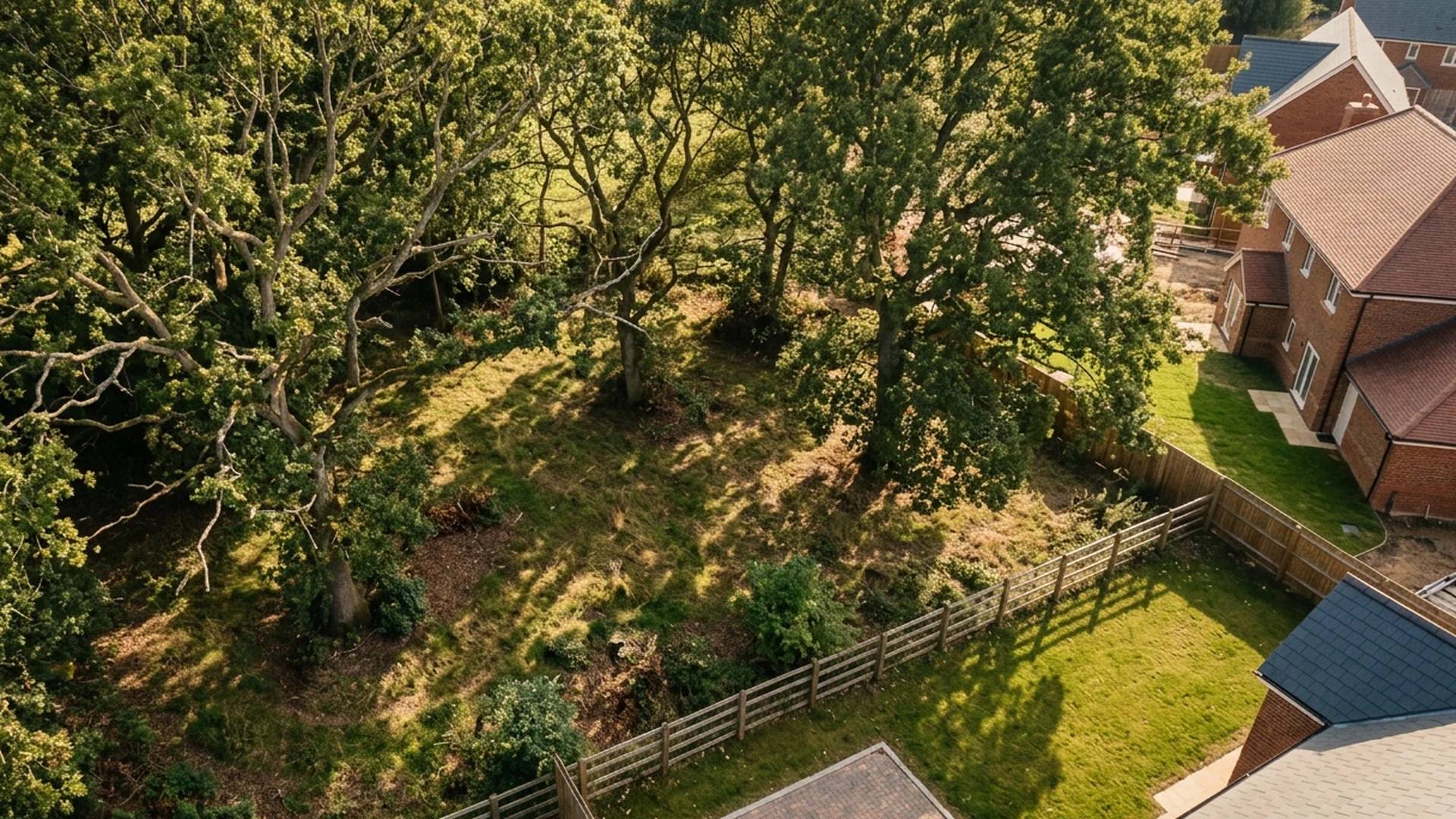
Reading a Tree Constraints Plan: What Architects Need
Learn how to read a tree constraints plan before fixing your layout. Understand RPAs, retention categories, and when to involve your arboriculturist.
What a Tree Constraints Plan Actually Shows (and What It Doesn’t)
A Tree Constraints Plan is a spatial document. It maps root protection areas, canopy spreads, and BS 5837 retention categories across a site, giving architects a scaled picture of where trees sit in relation to a proposed development. What it does not do is tell you what to build, where to position a building line, or which trees can be removed. That distinction matters enormously in practice.
Architects working from a TCP without arboricultural input often make one of two errors. The first is treating the plan as a green light for anything that falls outside the mapped circles. The second is assuming that a tree shown in a lower retention category is automatically available for removal. Neither reading is correct. The TCP is a starting point for design dialogue, not a set of instructions. Without understanding how the categories were assigned, how the root protection areas were calculated, and what structural or health issues may exist beneath the surface, the plan can mislead as easily as it informs.
The value of a TCP is that it concentrates complex arboricultural data into a format architects can overlay on a site plan. Used correctly, it shapes early massing decisions and prevents layouts from being drawn up around assumptions that will not survive pre application scrutiny. Used in isolation, it creates a false sense of certainty.
How to Read the Colour Coding and Retention Categories
BS 5837:2012 sets out a four category system for classifying trees surveyed as part of a development proposal. Category A trees are of high quality and value, with an expected remaining contribution of at least 40 years. Category B trees are of moderate quality and value, with a remaining contribution of at least 20 years. Category C trees are of low quality or value, typically with a remaining contribution of less than 20 years or with significant defects. Category U trees are those recommended for removal regardless of the development, usually because of serious structural failure, disease, or poor form.
BS 5837 Retention Categories
On a TCP, these categories are typically represented by colour coding, with each tree or group assigned a letter and a number for cross reference with the arboricultural survey schedule. The retention category tells you how the arboriculturist has assessed the tree’s current condition and long term contribution. It does not, on its own, confirm that a Category C or U tree can be removed without further process. Removal of trees subject to a Tree Preservation Order or within a Conservation Area requires consent regardless of their BS 5837 category. The category informs the planning officer’s view of loss, but it does not substitute for the consent process.
When reviewing a TCP, architects should read the retention categories alongside the survey schedule rather than treating the colour coding as a standalone instruction. The schedule will contain information about stem diameter, height, crown spread, and any identified defects that may affect how the tree should be treated in the design.
Root Protection Areas: The Numbers Behind the Circles
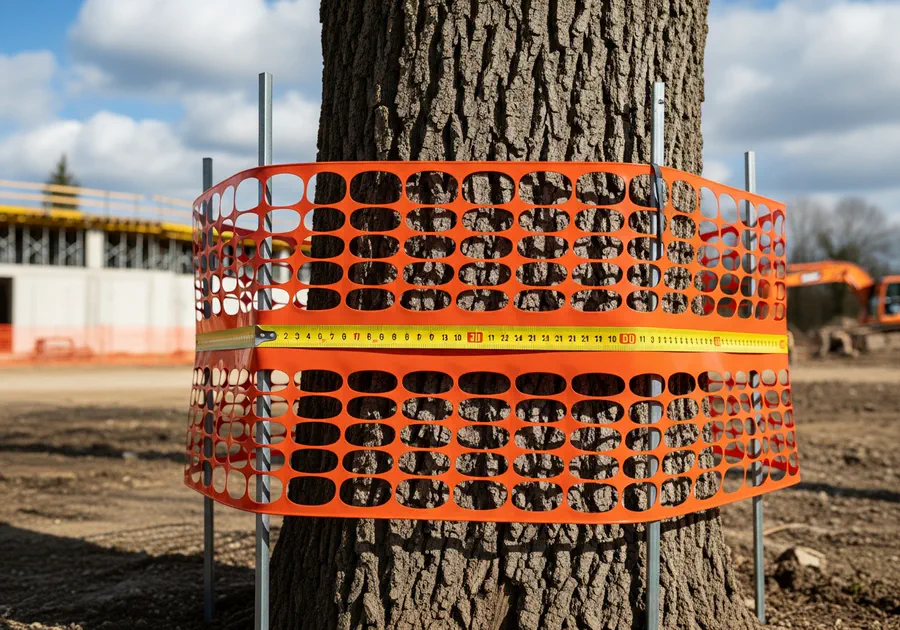
The circles on a TCP are not approximate guides or negotiable buffers. They are calculated minimum exclusion zones derived from a formula set out in BS 5837. The standard method calculates the root protection area as a circle with a radius equal to 12 times the stem diameter at breast height, measured in metres. For a tree with a stem diameter of 400 millimetres, that produces an RPA radius of 4.8 metres and a total RPA of approximately 72 square metres.
RPA Calculation
The RPA represents the area of soil within which the root system is most likely to be concentrated and most sensitive to disturbance. Encroachment into the RPA through excavation, compaction, changes in ground level, or the storage of materials during construction can cause irreversible damage to a tree, even if that damage does not become visible for several years.
A common misreading at the design stage is to treat the RPA boundary as a line that can be nudged. Architects sometimes assume that encroaching on 10 or 15 percent of an RPA is inherently acceptable because it falls below the threshold sometimes cited in guidance. That assumption is not reliable. The acceptability of any encroachment depends on which part of the RPA is affected, the species and condition of the tree, the nature of the works proposed, and whether a no dig specification or other mitigation can genuinely protect the root zone. These are arboricultural judgements, not geometric ones.
Overlapping Constraints and What They Mean for Layout Options
On many development sites, the constraints shown on a TCP do not sit in isolation. RPAs from adjacent trees overlap. Canopy spreads extend across site boundaries into neighbouring land. High category trees sit close to the proposed building footprint or directly above the line of a proposed access road. When these constraints stack, the design options narrow quickly.
Overlapping RPAs are particularly significant because the combined root zone of two or more trees may cover a much larger area of the site than either tree’s individual circle suggests. A layout that appears to thread neatly between two RPAs may still compromise both trees if the ground between them is disturbed during construction.
Canopy spreads that extend beyond the site boundary raise a different set of issues. The canopy itself may not be the primary concern, but the roots of a tree whose crown overhangs a neighbouring property will extend beneath the site, and those roots are not shown by the canopy line alone. An arboriculturist can advise on the likely root spread and whether any proposed works near the boundary are likely to affect a tree that sits outside the red line.
Where high category trees sit close to a proposed building footprint, the TCP should prompt a conversation about massing before the floor plan is fixed. Shifting a building line by two or three metres, adjusting the position of a garage or bin store, or rethinking the route of a service trench can make the difference between a scheme that works arboriculturally and one that requires significant redesign after pre application feedback.
The Questions to Ask Your Arboriculturist Before Fixing the Layout
The TCP stage is the right moment to put specific questions to the arboriculturist rather than waiting until a layout has been drawn up and submitted. The following questions will give architects the information they need to make informed design decisions.
Structural condition
Ask whether any trees shown as Category A or B have structural defects that may affect their long term retention. A tree that appears high value on the TCP may have internal decay or root plate issues that change the picture.Removal potential
Ask whether any Category C or U trees are subject to a TPO or sit within a Conservation Area, and what the realistic prospects are of obtaining consent for removal. Do not assume category alone determines removability.RPA flexibility
Ask what flexibility, if any, exists within specific RPAs under a no dig specification. Permeable paving, bridging structures, or hand dug trenches may allow limited encroachment in some circumstances, but this must be confirmed before it is built into a layout.Phasing and sequencing
Ask whether phased removal of lower category trees is possible and how that would interact with the construction programme. Early removal of consented trees before groundworks begin can simplify the protection regime on site.
These questions will not always produce the answers architects hope for, but they will produce accurate ones. Building a layout around an assumption that later proves wrong is far more costly than adjusting the design at Stage 2.
When the TCP Needs to Be Updated Before Planning Submission

A TCP reflects the condition of the site at the time of the survey. If significant time has passed between the original survey and the submission date, the plan may no longer be accurate. Trees may have been removed, new defects may have developed, or additional trees may have been identified that were not included in the original assessment. Planning authorities will expect the TCP to reflect current site conditions, and a discrepancy between the plan and what is visible on site will attract questions.
Design changes also trigger the need for a revised TCP. If the layout has moved since the original survey was carried out, the relationship between the proposed development and the mapped constraints will have changed. An arboriculturist will need to review the updated layout against the survey data and confirm whether the original TCP remains valid or whether a revised plan is required.
Additional survey data can also necessitate an update. If a ground investigation has revealed information about soil conditions or root distribution that was not available at the time of the original survey, the arboriculturist may need to revise the RPA calculations or update the retention categories before the scheme proceeds to submission.
How Early Arboricultural Engagement Saves Design Iterations
The most efficient point at which to involve an arboriculturist is RIBA Stage 2, when the site layout is being developed but before the massing and access strategy have been fixed. At this stage, the TCP becomes a working document rather than a retrospective constraint. The arboriculturist can advise on which trees are genuinely non negotiable, where flexibility exists within the RPA calculations, and how the layout can be shaped to achieve planning compliance without unnecessary loss of trees or abortive design work.
Architects who receive a TCP at pre application stage or, worse, at the point of submission are working with a constraint that has already been baked into a scheme. Adjustments at that stage are costly, time consuming, and often require the arboriculturist to produce additional reports to justify decisions that could have been made more cleanly at the outset.
The TCP is not the end of the arboricultural process. It is the beginning of it. An Arboricultural Impact Assessment, a method statement, and a tree protection plan will all follow as the scheme develops. But the quality of those later documents depends on the decisions made at the layout stage, and those decisions are only as good as the arboricultural input that informed them. Treating the TCP as a collaborative design tool rather than a document to be filed and worked around is the single most effective way to reduce arboricultural risk on a development site.
Frequently asked questions
Find out what's on your site before it becomes a problem.
Subito provides BS5837 tree surveys and arboricultural impact assessments for planning applications across England. If your site has old trees, we will identify them, assess them, and give you the information you need to design around them with confidence.