Reading an Arboricultural Impact Assessment With Your Layout
How to read an arboricultural impact assessment against your layout drawings: check revisions, trace RPAs, read the impact schedule and test mitigation.
Align the AIA with the correct layout revision, scale and north point
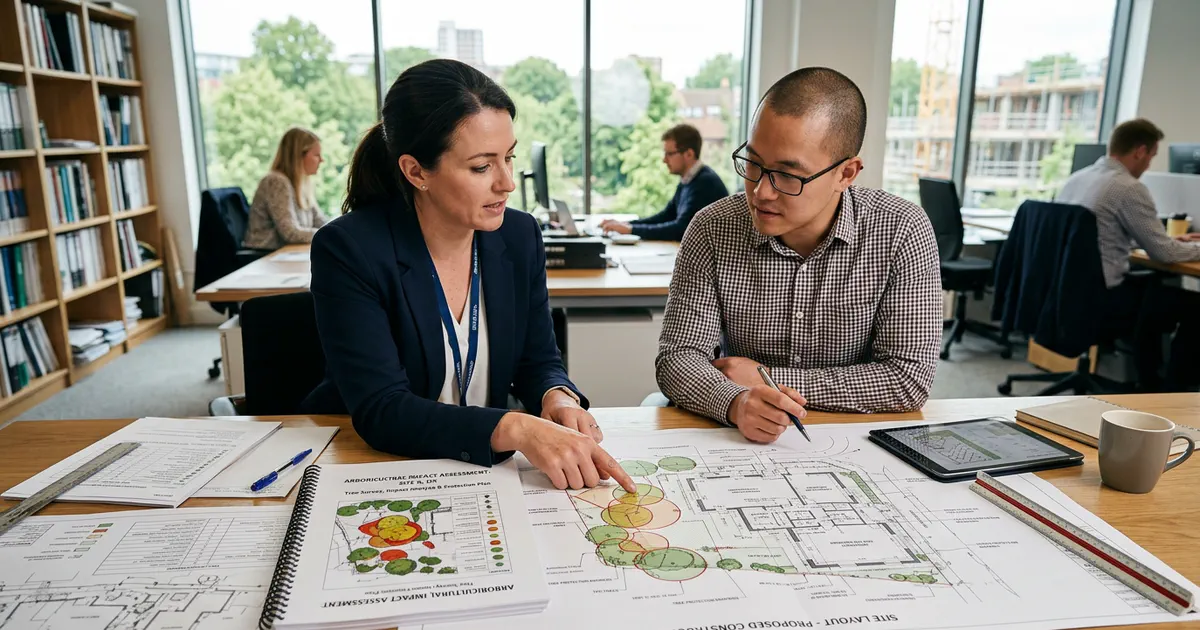
A surprising number of arboricultural conflicts turn out to be drawing conflicts. Before you compare a single impact, put the Arboricultural Impact Assessment, the Tree Constraints Plan and the proposed layout side by side and confirm they share the same revision, the same scale and the same north point. A layout issued at 1:200 against a plan at 1:500 will place canopies over buildings that are nowhere near them, and a rotated north point can shift an RPA across a proposed driveway.
Use the same tree references across all three documents. If the AIA schedule says T14 and the layout labels it T4, stop and get the references reconciled. The companion article on reading a Tree Constraints Plan is worth revisiting here, because the TCP is the bridge between the survey data and the design.
Trace tree numbers and Root Protection Areas onto your proposed layout
Take each T, G and H reference from the AIA tree schedule and find it on the layout. Then check what falls inside its Root Protection Area: proposed footprints, hardstanding, drainage runs, and any level changes. This is the step that turns the AIA from a report you file into a spatial check against the design.
RPA radius calculation
Watch for level changes in particular. A 300mm cut within an RPA is a different conversation from a 300mm fill, and neither always appears on a layout that only shows finished floor levels.
Read the impact schedule as a line-by-line design conflict register
Work through each row of the AIA impact table and compare the proposed works, impact rating and mitigation to the corresponding area on the layout. Flag any row that implies a layout change, tree removal or construction method not shown on the drawings. A row stating “minor encroachment, no-dig surfacing” is only minor if the layout actually shows no-dig surfacing there.
Check whether tree protection measures actually fit the site layout
Review the tree protection plan and confirm fencing, ground protection, access routes, compounds and service runs can be accommodated without conflicting with the proposed layout. Identify pinch points where the design and protection zones compete for space. On tight urban sites, the compound and the RPA fencing routinely want the same square metres, and that is better resolved at design stage than at condition discharge.
Test mitigation and residual impact against the design rationale
Read the avoidance and mitigation measures alongside the layout to see whether conflicts have been designed out or merely managed. Check whether any residual tree loss or RPA encroachment is clearly justified and likely to be accepted in planning. If a category B tree is being lost to gain two parking spaces, expect the case officer to ask why.
Cross-reference arboricultural method statements with levels and construction details
For no-dig surfaces, hand-digging, root barriers or monitoring, confirm the architect’s levels, sections and construction details make the method physically achievable. A cellular confinement system needs a build-up that fits the available depth, and a root barrier needs a trench the services can actually use. This is where many AIA recommendations fail at condition discharge or on site.
Extract actions for the planning submission, conditions and consultant coordination
Use the AIA to brief the design team, planning statement and discharge strategy, recording layout changes, protection measures and monitoring requirements. Frame the exercise as reading the AIA alongside layout drawings, not as a one-off report review. The actions you extract here are what carry the scheme through conditions.
Frequently asked questions
Find out what's on your site before it becomes a problem.
Subito provides BS5837 tree surveys and arboricultural impact assessments for planning applications across England. If your site has old trees, we will identify them, assess them, and give you the information you need to design around them with confidence.