Tree Planting Targets Are Off Track. What It Means for Developers.
England's tree planting targets are being missed by wide margins. That pressure is shifting into the planning system — and it is showing up in the conditions being attached to consents right now.
The government set out to treble tree planting rates in England. It hasn’t come close. And the gap between ambition and delivery is now creating real consequences for developers — not in some abstract policy sense, but in the conditions being attached to planning consents right now.
Here’s what’s happening, and what you need to know before your next application goes in.
The targets and the shortfall
England has a legally binding target to reach 16.5% woodland and tree canopy cover by 2050, up from 14.9% in 2022. To get there, the government needs to plant significantly more trees each year than it currently does.
The numbers tell a stark story. The UK government set a goal of planting 30,000 hectares of new woodland each year. In 2024/25, only around half that was achieved across England, Scotland, Wales, and Northern Ireland. In England alone, Defra’s Nature for Climate Programme directly funded just 6,324 hectares of tree planting in 2024/25, against a target of 7,500 hectares. Over the five year life of the programme, it hit 53% of its cumulative tree planting target.
Drought has made things worse. More than 821,000 saplings — around 22% of those planted in 2024/25 — died during the dry conditions of last summer, pushing totals further from where they need to be.
The government knows the trajectory is wrong. A Trees Action Plan is due to be published later this year, and the March 2026 Land Use Framework explicitly identified tree planting as an area where delivery needs to accelerate substantially.
Why this matters for your planning application
When the government misses its own tree planting targets, the pressure does not disappear. It shifts. And one of the places it shifts to is the planning system.
Local planning authorities are increasingly under pressure to demonstrate that development in their area is not reducing tree canopy cover, and where removal is unavoidable, that meaningful replacement planting is secured. This shows up in planning conditions.
Replanting conditions are not new. But they are becoming more detailed, more demanding, and more closely scrutinised. Authorities are specifying exact species, minimum trunk girths, planting locations, and maintenance obligations that run for five years or longer after completion. Some are requiring replacement at a ratio greater than one to one, particularly where removed trees were of high amenity value or ecological significance.
In areas where LPAs have recently published updated trees and development guidance — as several have in 2025 and 2026 — expectations around new planting as part of any scheme are rising. The assumption that a small financial contribution or a token landscaping plan will satisfy the tree officer is no longer a safe one.
What this looks like in practice
If your site has trees — even trees you intend to remove, with consent — you are likely to face scrutiny on three fronts:
What is being lost. The quality classification of removed trees under BS5837 determines how significant their loss is judged to be. Category A and B trees carry weight. Removing them without a credible replacement strategy is increasingly difficult to justify.
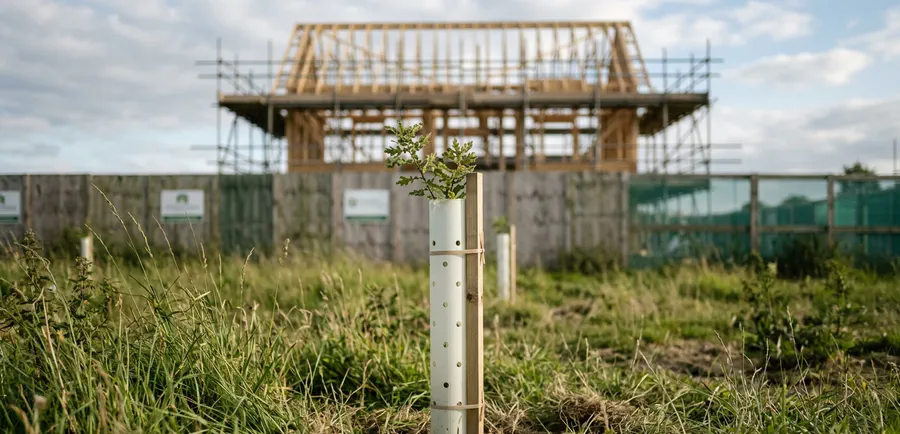
What is being replaced. Replacement planting proposals need to be specific and proportionate. Vague references to “soft landscaping” or “boundary planting” are not enough. Tree officers want species, sizes, locations, and a maintenance schedule.
What is being protected. Retained trees need to be properly protected during construction. Conditions requiring a tree protection plan and arboricultural supervision are standard on any site where retained trees are near working areas.
Getting ahead of all three is the difference between a smooth consent and a drawn out negotiation with conditions that delay your start on site.
The practical implication
The shortfall in national tree planting targets is not your problem to solve. But it is the context in which your application will be assessed. Tree officers are not operating in isolation from the wider policy environment, and that environment is telling them to hold the line on canopy loss and push hard for meaningful replacement.
The developer who goes in with a comprehensive arboricultural submission — one that demonstrates what is being retained, what is being removed and why, and what credible replacement planting is proposed — is in a fundamentally different position to the developer who is working it out under condition after consent.
Early arboricultural input shapes the design. It identifies which trees can realistically be retained, which cannot, and where replacement planting can be located to satisfy the authority without compromising your scheme. That conversation is worth having before the drawings are finalised, not after the planning officer has raised concerns.