Tree Survey for Backland Plot with TPO Neighbours
A guide for developers on the specific arboricultural reports needed for a backland plot with neighbouring TPO trees. Covers BS 5837, AIA, and AMS.
The Challenge: Backland Plots and Neighbouring TPOs
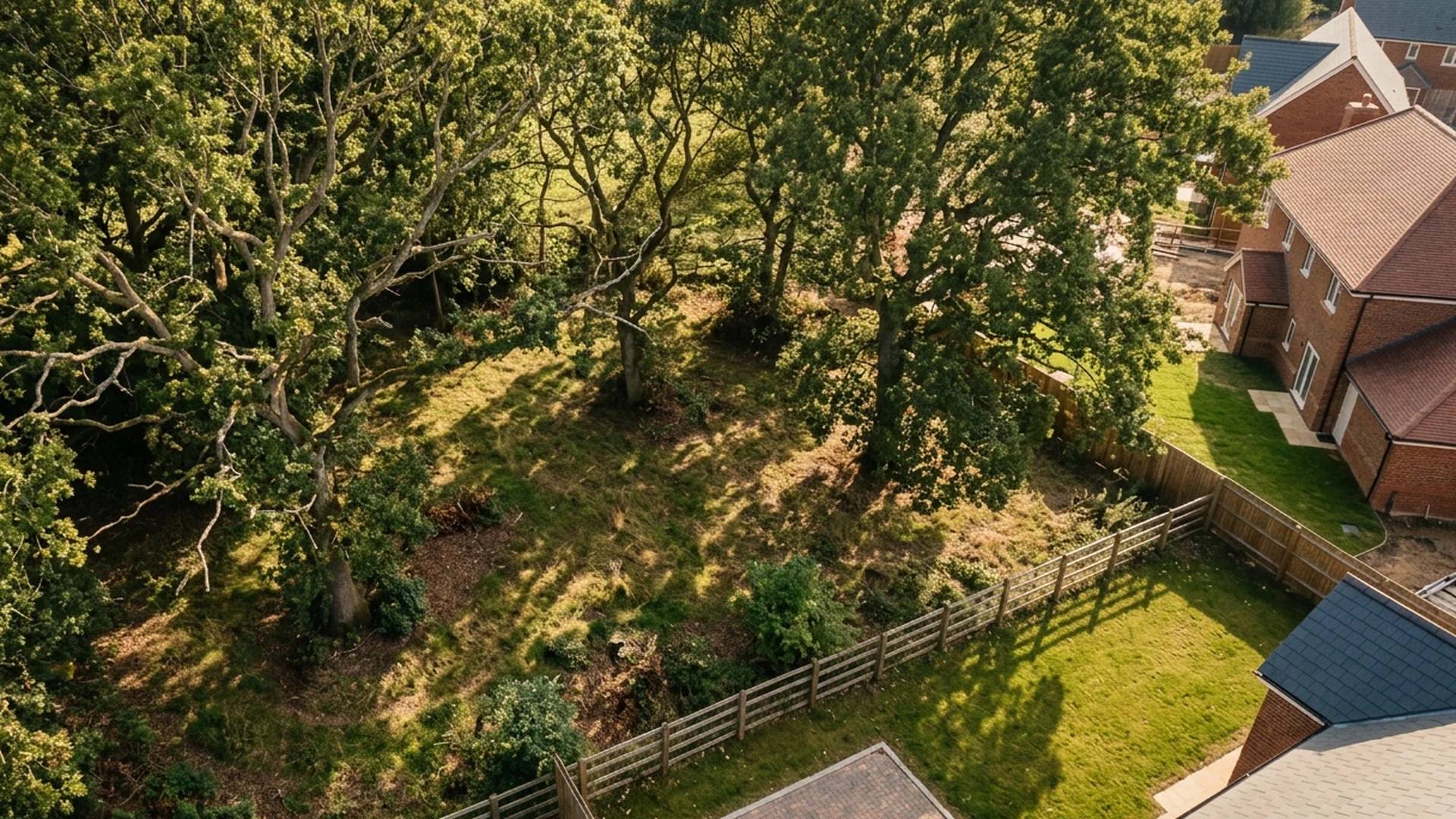
Backland development presents a unique set of spatial constraints. These plots, often located behind existing properties, typically have restricted access and limited working space. The development footprint is squeezed by boundaries on all sides, making every square metre critical. This situation becomes significantly more complex when trees on neighbouring properties are protected by a Tree Preservation Order (TPO).
The presence of a neighbouring TPO tree fundamentally changes the planning dynamic. The Local Planning Authority (LPA) has a statutory duty to protect these trees. Any development proposal that could potentially affect them will face intense scrutiny. It does not matter that the trees are not on your land. The LPA’s concern is the potential for direct or indirect damage to a legally protected asset. They will assess your application based on its ability to coexist with these trees for their entire life expectancy, not just through the construction phase.

Why a Standard BS 5837 Survey is Not Enough
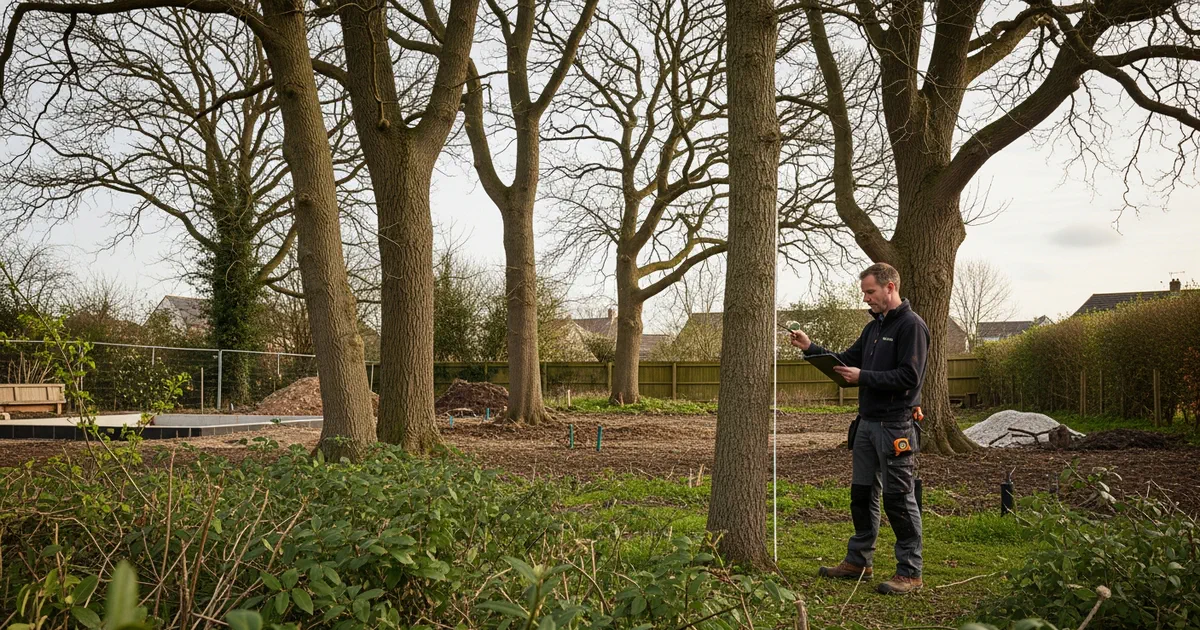
A tree survey conducted in accordance with British Standard 5837:2012 is the essential starting point for any development site. This survey provides a baseline inventory of the trees, recording their species, size, age, and condition. It categorises each tree based on its quality and value, from high-quality Category A trees to low-quality Category C or unsuitable Category U trees. Crucially, it calculates the Root Protection Area (RPA) for each tree, which is the minimum area of ground that must be left undisturbed to ensure its survival.
Root Protection Area (RPA)
For a simple, unconstrained site, this survey and its accompanying Tree Constraints Plan might be sufficient. However, for a backland plot with adjacent TPO trees, it is merely the first step. A standard BS 5837 report identifies the constraints but does not solve the problem. The LPA’s tree officer already knows the TPO trees are a constraint. What they need to see is a detailed analysis of how your specific development proposal will interact with those constraints. A standard survey does not provide this. It will not demonstrate how you plan to build a house, install services, and gain access to the site without causing harm to the very trees the LPA is legally obliged to protect.
The Arboricultural Impact Assessment (AIA): Demonstrating Viability
The Arboricultural Impact Assessment (AIA) is the critical document that bridges the gap between the tree survey and the planning application. It moves beyond simply identifying trees and analyses the direct and indirect effects of the proposed development on them. For a backland plot with TPO neighbours, the AIA is where you make the case for the project’s viability. It must be a robust, evidence-based report that anticipates and addresses every potential point of conflict.
Direct Impacts
Direct Impacts on TPO Trees
The AIA must meticulously detail any direct impacts. This includes any part of the development that physically touches the tree or enters its calculated protection zone. The proposed building’s position relative to the neighbouring TPO tree is the primary consideration. We assess if the building’s walls, eaves, or roof will conflict with the tree’s canopy. If so, the AIA must specify the exact pruning required, justifying it in accordance with arboricultural best practice to show it will not harm the tree’s health or amenity value.
Equally important is any incursion into the Root Protection Area. The AIA will quantify the exact area and percentage of any proposed RPA incursion from foundations, patios, or driveways. It will analyse the likely impact of this root loss on the tree’s stability and long-term health, providing a clear justification for why the incursion is acceptable or proposing mitigation to offset the impact.
Indirect Impacts
Indirect Impacts and Future Pressures
LPAs are increasingly focused on the long-term relationship between a new dwelling and existing trees. The AIA must therefore address indirect and future pressures. Shading is a major concern. The report will analyse the path of the sun throughout the day and year to determine how the TPO tree’s canopy will cast shadow over the new house and garden. This demonstrates foresight. It shows the LPA that the property will have adequate natural light and that future residents will not feel compelled to submit repeated applications to heavily prune the protected tree, creating a cycle of conflict.
The AIA also examines the practicalities of construction. It considers how services like water, gas, and drainage will be installed. It evaluates site access for machinery and the location for storing materials and mixing cement. Each of these activities poses a risk to the TPO tree’s roots through excavation or soil compaction. The AIA must show how these necessary construction activities can be achieved without causing damage within the RPA.
The Arboricultural Method Statement (AMS): The Practical Plan
If the AIA is the argument for why the development is acceptable, the Arboricultural Method Statement (AMS) is the detailed instruction manual for how it will be built safely. This document provides the LPA with the confidence that the protective measures outlined in the AIA are not just theoretical. It translates principles into a sequence of specific, enforceable actions for the construction team. For a constrained backland site, a detailed AMS is non-negotiable and often secured by a planning condition.
Foundation Design and Justification
Conventional strip foundations are highly destructive to tree roots and are rarely acceptable within an RPA. The AMS must specify a suitable low-impact foundation design. This often involves specialist engineering solutions such as a piled foundation with a suspended ground beam or screw piles. The AMS provides the arboricultural justification for the chosen method. It explains precisely how this design minimises excavation, avoids severing major roots, and ensures the load of the new building is distributed away from the sensitive root zone of the TPO tree. This section demonstrates a joined-up approach between the arboriculturist and the project engineer.
Access and Ground Protection
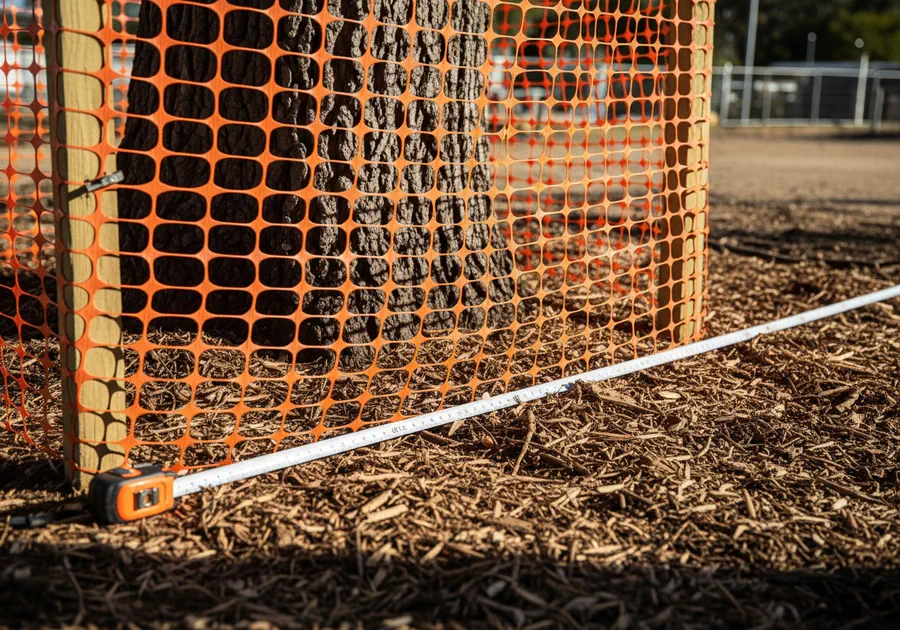
Construction traffic, even just a mini digger, can cause devastating soil compaction, starving roots of oxygen and water. The AMS will detail the ground protection strategy. Where temporary access is unavoidable within the RPA of the TPO tree, it will specify the use of appropriate ground protection. This could be a cellular confinement system like Cellweb, which spreads the load of machinery and prevents compaction. The statement will include a plan showing the exact location of this protection and the sequence for its installation and removal. Any necessary pruning to allow machinery to pass without damaging branches, known as access facilitation pruning, will also be detailed and justified.
Installation of Services
Service trenches are a common cause of severe root damage. The AMS will prohibit standard trenching techniques within any RPA. Instead, it will prescribe trenchless or minimal excavation methods. This might involve using a directional drill to bore a conduit for services underneath the root system, or careful hand digging with an air spade to expose roots without damaging them. The AMS provides a step-by-step methodology for these specialist tasks, ensuring they are carried out with precision and under the watch of the project arboriculturist.
Site Supervision Schedule
To ensure compliance, the AMS must include a schedule of arboricultural site supervision. This is a commitment to the LPA that a qualified consultant will be present at key stages of the construction process. These critical stages typically include the installation of tree protection fencing, the excavation for foundations near the RPA, the installation of services within the RPA, and the removal of ground protection. The consultant’s role is to oversee the work, provide advice to the contractors, and document the process, providing the LPA with a clear audit trail of compliance.
Engaging with the Local Authority Tree Officer
Proactive engagement with the LPA’s tree officer is fundamental to de-risking a planning application on a sensitive site. The objective is to build confidence and resolve potential issues before the application is determined. A confrontational or evasive approach is counterproductive. The goal is collaboration.
Submit a Comprehensive Pack
The process should begin with the submission of a comprehensive package of documents: the BS 5837 survey, the detailed Arboricultural Impact Assessment, and a robust draft Arboricultural Method Statement. This demonstrates a thorough and professional approach from the outset.Request a Site Meeting
Following submission, the project’s arboricultural consultant should offer to meet the tree officer on site. This meeting is an opportunity to walk through the constraints and explain the proposed solutions in a practical context.Explain the Solutions
The consultant can physically point out the location of protective fencing, explain the rationale behind the chosen foundation design, and answer technical questions about the likely impact of the development. This direct communication allows the tree officer to understand the thought process and be assured that the protection of the TPO trees is a central consideration, not an afterthought.Achieve Smoother Approval
This collaborative approach frequently results in a smoother path to approval. It can help shape pragmatic and reasonable planning conditions, avoiding the uncertainty and cost of an appeal against a refusal.
Find out what's on your site before it becomes a problem.
Subito provides BS5837 tree surveys and arboricultural impact assessments for planning applications across England. If your site has old trees, we will identify them, assess them, and give you the information you need to design around them with confidence.