What a Bat Survey Actually Involves — and Why You Cannot Afford to Skip One
Bat survey explained for UK planning — PRA and emergence surveys, BCT guidelines, seasonal windows May–October, EPS licensing and how to get a fixed quote.
Bat surveys are one of the most misunderstood requirements in development. Developers either do not know they need one until a planning officer flags it, or they assume it is a quick box-tick and are then surprised when the survey window closes and their programme stalls for months.
Getting ahead of it is straightforward. Not getting ahead of it is expensive.
Here is what is actually involved.
Why bats stop developments in their tracks
All 18 species of bat found in the UK are fully protected under the Wildlife and Countryside Act 1981 and the Conservation of Habitats and Species Regulations 2017. It is a criminal offence to disturb a bat, damage a roost, or carry out works that destroy a bat’s resting place — even if no bats are present in the roost at the time.
Natural England’s standing advice makes clear that the presence or absence of bats must be established before planning permission is granted. Your LPA cannot lawfully approve a scheme where bat interest has not been properly assessed. If your application does not include the right survey evidence, it will not be validated or it will be refused.
The risk does not end at consent. If bats are discovered once works have started, work must stop immediately and a licence obtained from Natural England before it can resume. That is a project-stopping event.
What a bat survey involves
Bat surveys follow the Bat Conservation Trust’s Good Practice Guidelines (4th edition), the recognised methodology for ecological survey work in the planning context. Most surveys run in two stages.
Stage 1: Preliminary Roost Assessment (PRA)
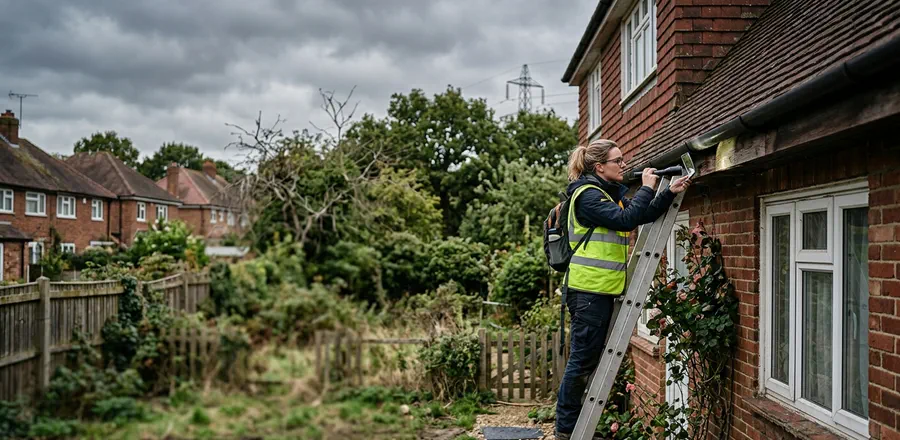
A qualified ecologist visits the site during daylight and assesses every structure and tree for features that could support bat roosts — crevices, exposed timbers, loose tiles, cavities, and suitable bark on mature trees. The assessment also considers the surrounding habitat: hedgerows, watercourses, and woodland that bats use as commuting and foraging routes. The ecologist assigns a roost potential rating and recommends whether further survey work is needed.
If the PRA finds negligible roost potential, that is often sufficient to satisfy the planning authority. Most sites with older buildings, mature trees, or habitat connectivity will require further survey.
Stage 2: Emergence and re-entry surveys
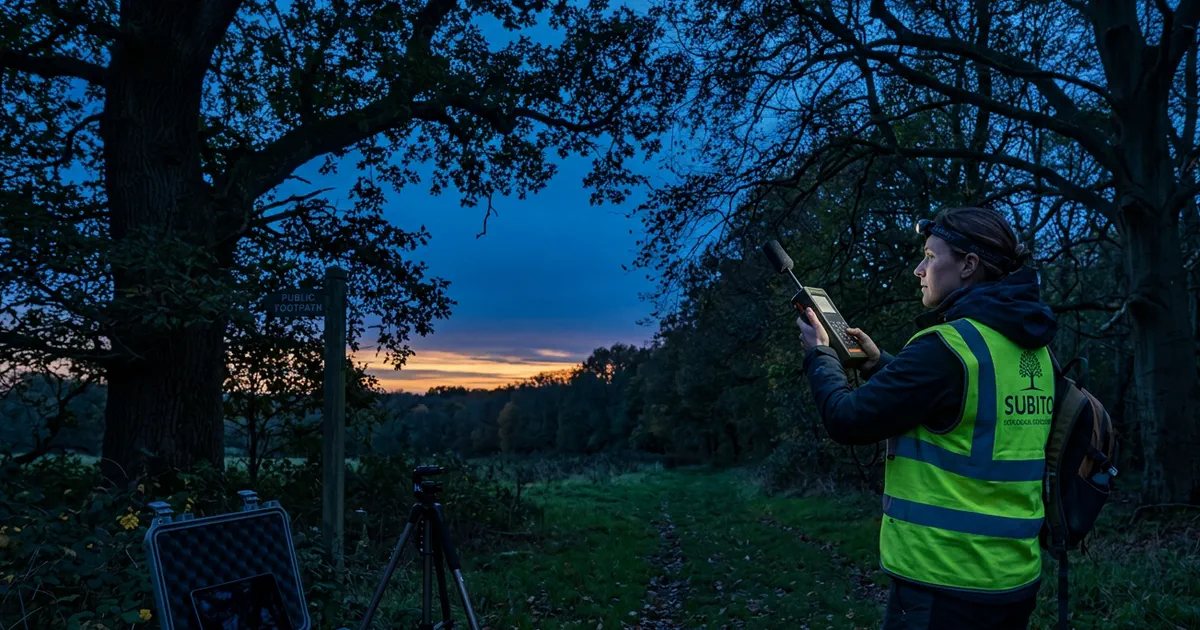
Where roost potential is identified, the ecologist returns at dusk and dawn to observe bat activity using specialist bat detection equipment. Bats are recorded as they emerge from or return to roosts, allowing the ecologist to identify species, estimate numbers, and assess how the roost is being used. The number of survey visits required depends on the species suspected and the roost type — a standard residential scheme typically requires two to four visits.
The completed report sets out the findings, confirms whether a bat roost is present, and recommends the mitigation measures or licensing required before works can proceed.
We scope and deliver the full sequence — from preliminary roost assessment through to EPS licensing — so your planning submission and lawful start on site stay aligned.
The timing problem most developers miss
Bat surveys can only be carried out during the active season, broadly May to October, with the optimal window for most roost types falling between May and August. Outside that window, bats are in hibernation and survey results are not reliable enough to satisfy your planning authority or Natural England.
If you commission a survey in September for a scheme you want to start in January, you may find the survey window has closed before you have the evidence you need — pushing your start date back by the best part of a year.
Commission your bat survey as early in the design process as possible. If a PRA flags roost potential in autumn or winter, your ecologist can advise on interim measures and programme the emergence surveys for the following spring.
What comes next
Where a roost is confirmed, works that would disturb or destroy it require a European Protected Species licence from Natural England. Your ecologist will design a mitigation scheme — typically including roost replacement features such as bat boxes or integrated roost tiles — and submit the licence application on your behalf. Consent and licensing can run in parallel, but the licence must be in place before sensitive works begin.
If your site has trees as well as structures, bat and tree survey work can be scoped together and delivered by the same team — see our tree surveys and bat survey services for coordinated scoping.
Get your quote in minutes
Bat surveys are priced based on site size, structure type, and the number of survey visits required. Enter your project details and you will have a fixed, itemised quote to work from.
FAQ