Surveys from £295
Bat Surveys and EPS Licensing
Bats are among the most frequently encountered protected species on development sites and among the most legally significant. We carry out the full sequence from preliminary roost assessment through to emergence surveys and EPS mitigation licence, so demolition, conversion, or sensitive works only proceed when the bat route is clear and lawful.
Overview
Getting the Bat Process Right From the Start
All 18 UK bat species are European Protected Species. It is a criminal offence to deliberately kill, injure, or disturb them, or to obstruct access to a roost whether or not bats are present at the time. For development that involves buildings, trees, or structures with roosting potential, the bat survey process is not optional: it runs from initial scoping through to a mitigation licence that must be in place before works affecting a roost can lawfully start.
The process has a fixed sequence. A preliminary roost assessment establishes whether bats are likely present and whether emergence surveys are needed. Where they are, those surveys must be carried out between May and September, at least two weeks apart. If a roost is confirmed and cannot be avoided, an EPS mitigation licence must be obtained from Natural England after planning consent is granted before any works can begin.
We manage the entire sequence as a connected instruction, from the first scoping visit to licence issue, so nothing falls between the gaps and your programme is not held up by a survey that should have been booked three months earlier.
For great crested newts, reptiles, breeding birds, and other species, we carry those surveys under our ecology surveys workstream and align timings so your overall ecology pack stays coherent.
Process
How it works
Get an accurate, fixed-price quote in minutes. Then it's simply book, survey, and report.
Create your quote
Tell us about your site and your project. We'll identify the surveys you need and produce a formal quotation on the spot.
Confirm your booking
Choose a date and we'll take it from there. You'll know who's coming, when, and what they need from you.
Get your report
Your report lands within a few working days of the survey. It covers everything your planning authority needs.
FAQ
Bat Surveys and EPS Licensing — Your Questions Answered
Why bats create specific challenges for development
Bats present a combination of factors that no other UK protected species does in quite the same way. They roost in buildings, trees, and structures that development routinely affects. They are creatures of habit that return to the same roosts year after year, meaning a roost disturbed or destroyed without a licence carries real legal consequences. And the survey season for confirming their presence or likely absence is limited to the warmer months, which means a missed window can delay a programme by a full year.
Beyond the legal risk, bats are ecologically significant. Roost types vary in their conservation importance: a maternity colony of a rare species carries far greater weight than a single pipistrelle night roost, and the mitigation required reflects that difference. Understanding what is present, where, and how it is using the site is what makes the difference between a proportionate mitigation approach and one that is over-engineered, under-resourced, or refused by Natural England.
Stage 1: The preliminary roost assessment
The preliminary roost assessment (PRA) is the starting point for any bat survey process. It is a daytime inspection carried out by a licensed ecologist that can take place at any time of year, with no seasonal restriction.
The ecologist inspects the building or structure externally and, where safe access permits, internally. They assess every feature with potential to support roosting bats: gaps in rooflines, accessible soffits, exposed timbers, loose render, cavities in walls, and any spaces where temperature, humidity, and shelter might suit a roosting bat. They also look for physical evidence of bat occupation: droppings, urine staining, dead bats, and feeding remains.
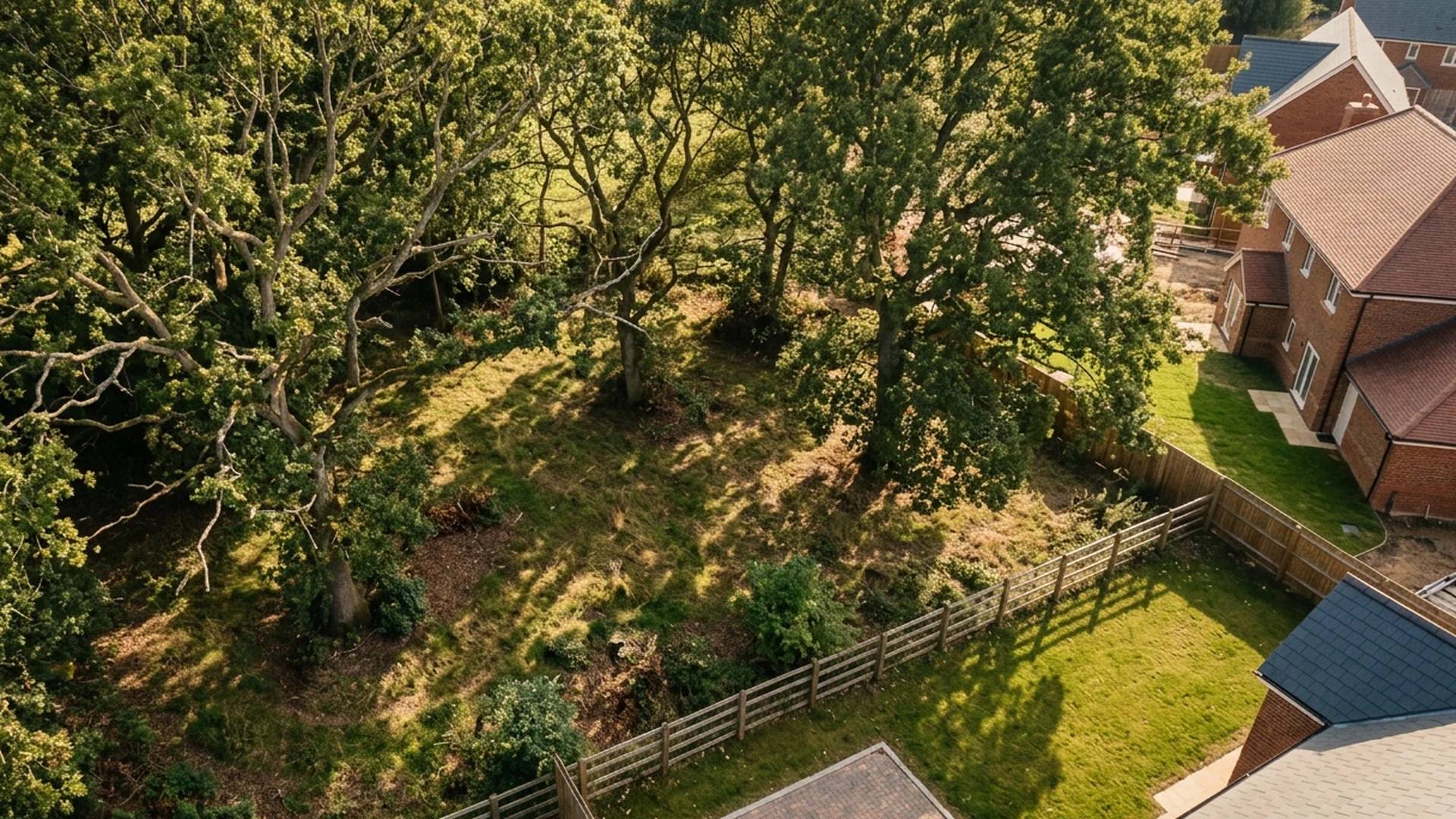
Trees are assessed where the development involves felling, pruning, or works that could affect features such as cavities, cracks, loose bark, dense ivy, or woodpecker holes. Each feature is assessed for its roosting potential.
The PRA produces a suitability category for each structure or tree and determines whether further surveys are required. Where the assessment concludes that the site has negligible potential for roosting bats, the PRA report supports the planning application and no further bat survey work is needed. Where potential or evidence is identified, bat emergence and re-entry surveys are required.
Stage 2: Bat emergence and re-entry surveys
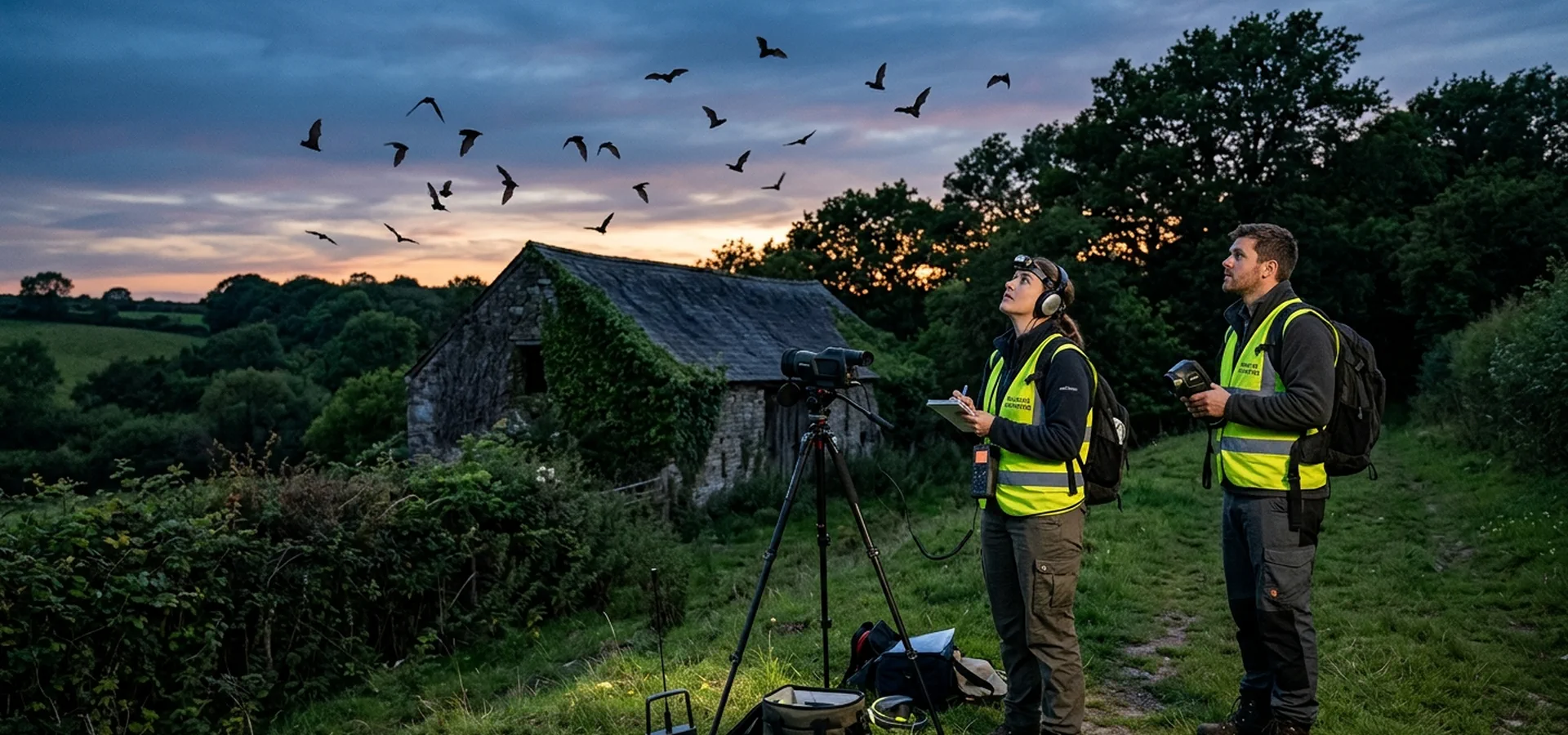
Bat emergence and re-entry surveys (BERS) are carried out at dusk and dawn to observe bats leaving and returning to the roost. They establish whether bats are present, which species are roosting, how many individuals are involved, and where the access points are. That information defines the roost type, which in turn determines the mitigation approach and the content of the licence application.
Surveys must be carried out between May and September, in accordance with Bat Conservation Trust good practice guidelines. April and October are a suboptimal period and results from those months may not be accepted by the planning authority without qualification. Each pair of surveys must be at least 14 days apart, and a sufficient number must be completed before the end of August.
The number of visits required depends on the roosting potential identified in the PRA. Low potential structures typically require two visits. Moderate potential requires three. High potential or structures with evidence of multiple roost types may require additional visits to fully characterise use across the season.
At each survey, licensed ecologists cover all potential access points simultaneously, recording bats using full-spectrum bat detectors. Species identification is confirmed through analysis of the acoustic recordings after the survey. The results are combined to produce a roost characterisation covering species, numbers, roost type, and access point locations.
Roost types and why they matter
Not all roosts carry the same level of legal protection or mitigation requirement. The roost type identified during the emergence surveys determines what the development must do to address the impact.
A maternity roost, used by female bats to give birth to and raise pups between May and August, is the most sensitive roost type. Disturbance to an active maternity roost is a serious offence and Natural England takes a precautionary approach to licences that involve them. Maternity roosts require the most detailed mitigation planning, the most robust replacement features, and in some cases a requirement to complete works outside the maternity season entirely.
A hibernation roost, used between November and March when bats are torpid, cannot be disturbed or opened up during the hibernation period without an emergency licence. Hibernation surveys require a separate specialist assessment using endoscopic equipment and are carried out by ecologists holding the appropriate class licence.
Transitional roosts and night roosts are used for roosting at other times of year and typically carry lower mitigation requirements, though they still need to be addressed in the licence application.
Bat activity surveys for habitat and lighting assessments
Where development involves the loss of foraging or commuting habitat rather than a direct roost impact, bat activity surveys establish how bats are using the site and what the development would do to their flight lines, feeding areas, and connectivity routes.
Activity surveys use walked transects with bat detectors and static detector units left on site for periods of continuous recording. The results identify species using the site, flight line directions and crossing points, and relative activity levels in different habitat areas. This data feeds into the ecological impact assessment, informs the design of sensitive lighting proposals, and supports the biodiversity net gain calculation where bat-beneficial habitat features are included.
Foraging habitat assessments are also required where development affects habitats adjacent to a known roost: hedgerows, tree lines, woodland edges, and water bodies are all significant for bats and their loss or degradation can affect roost viability even where the roost itself is untouched.
The EPS mitigation licence
Where a roost is confirmed present and the development cannot avoid affecting it, an EPS mitigation licence must be obtained from Natural England before any works affecting the roost can begin. The licence permits activities that would otherwise be illegal: disturbing bats, obstructing access to roosts, and in some cases destroying roosts, subject to the conditions it specifies.
A licence application can only be submitted after planning permission has been granted. It must demonstrate that the three legal tests are met: that there is an imperative reason of overriding public interest for the development, that no satisfactory alternative exists that would avoid the impact, and that the works will not be detrimental to the favourable conservation status of the affected bat species.
The application includes the completed bat survey data, a mitigation strategy setting out how impacts will be minimised and what replacement roosting features will be provided, and a monitoring plan. Natural England has up to 30 working days to determine a licence application. Building that processing time into the programme from the start avoids a gap between planning consent and the start of works.
What replacement roost features look like
Where a roost is lost or disturbed under licence, Natural England requires that equivalent or better roosting opportunities are provided as compensation. The type and number of replacement features depend on the species involved, the roost type, and the number of individuals affected.
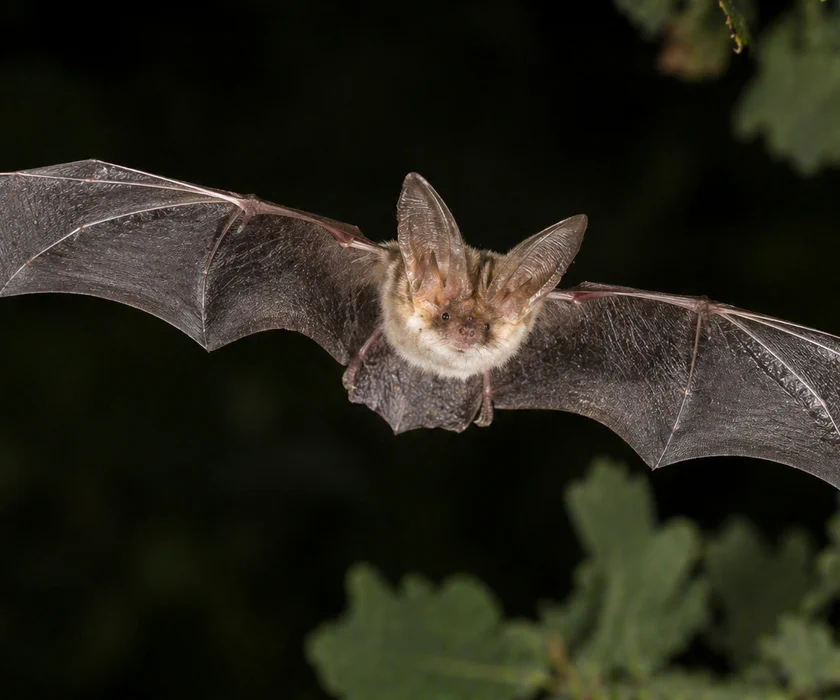
For common species such as common pipistrelle or brown long-eared bat, replacement features typically include purpose-made bat boxes or integrated bat bricks installed in retained or new structures, with features matched to the roosting preferences of the species found. For more sensitive species or larger roosts, purpose-built bat lofts, accessible roof voids with appropriate temperature and humidity conditions, or external roosting structures may be required.
Replacement features must be in place and accessible before the roost they replace is disturbed. Post-development monitoring confirms whether bats have adopted the new features and feeds into the licence conditions that typically run for two or more years after the development is complete.
What it costs and how to get started
Bat survey costs depend on the type and complexity of the survey required, the number of structures or trees to be assessed, the number of emergence survey visits needed, and the location of the site. PRA visits are priced per structure. Emergence survey costs include the survey visits, acoustic analysis, and the written report. Licence application fees are quoted separately once the survey results are known.
Given the survey season constraints, early planning is essential. A project that needs emergence surveys and a licence before demolition can begin needs the PRA completed and surveys booked before May. To get a quote, provide us with your site address, a description of the structures or trees involved, and any existing ecological information. We will advise on the survey sequence, the likely programme, and provide a fixed price for each stage.
Deliverables
Bat evidence and licensing, built around your programme
PRA through to bat EPS submission — proportionate survey effort, statutory seasonal windows, and reporting structured for planners and Natural England.
Get started today
Let's move your site forward.
Fixed pricing in 4 minutes. No commitment until you book.