eDNA
Great Crested Newt eDNA Survey
Lab-tested pond water for great crested newt DNA — a fast presence or absence answer in the statutory window, with negative results accepted by Natural England and planning authorities.
Overview
A Faster, Less Disruptive Route to an Answer
Where an HSI assessment identifies ponds with moderate to excellent habitat suitability, the next step is to establish whether great crested newts are actually present. The eDNA survey does this without the cost or programme implications of a full traditional survey: a water sample is taken from each scoped pond, sent to an accredited laboratory, and tested for genetic material shed by newts during the breeding season.
A negative eDNA result from a pond with good habitat suitability is strong evidence that great crested newts are absent. For many development sites, that single result resolves the protected species question entirely and removes the need for any further survey work.
The statutory window for eDNA sampling runs from 15 April to 30 June. Planning your programme around this window is straightforward if the HSI is commissioned early enough. If you miss it, the next opportunity is twelve months away.
FAQ
Great Crested Newt eDNA Surveys — Your Questions Answered
What eDNA sampling is and how it works
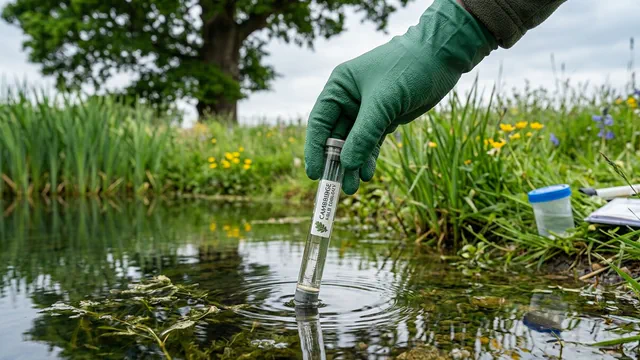
Environmental DNA is genetic material shed by animals into their surroundings through skin secretions, mucus, faeces, and other biological traces. During the breeding season, great crested newts are active in and around ponds and shed detectable quantities of DNA into the water. A water sample collected during this period and tested by an accredited laboratory can confirm whether that genetic material is present.
The approach was approved by Natural England for use in planning surveys in 2014 following a Defra-funded trial and has been standard practice ever since. It is non-invasive, requires no disturbance to the pond or its surroundings, and produces a presence or absence result without the need for torching, bottle trapping, or multiple site visits.
The protocol is published by the Freshwater Habitats Trust and must be followed precisely for the results to be accepted by Natural England and planning authorities. Samples must be taken by a licensed ecologist, handled in accordance with the chain of custody requirements, and processed by a UKAS-accredited laboratory within the required timeframe.
The statutory survey window and why timing matters
The eDNA survey can only be carried out between 15 April and 30 June. This window coincides with the great crested newt breeding season, when adults are active in ponds and DNA concentrations in the water are sufficient for reliable detection. Outside this period, DNA levels drop as newts leave the water and spend the remainder of the year in terrestrial habitat. Results taken outside the window are not accepted as evidence of absence and cannot be used to support a planning application.
The window is 76 days. Within that period, laboratory processing times, chain of custody requirements, and the need to coordinate site access mean that bookings fill quickly from mid-April onwards. If your planning programme requires eDNA results before the summer, the HSI assessment and survey booking should be in place well before the window opens.
Missing the eDNA window does not mean the survey cannot be done. It means it cannot be done until the following April. For time-sensitive programmes, that is a twelve-month delay.
How the field sampling is carried out
The sampling visit is straightforward and low impact. The ecologist takes multiple water samples from different points around each pond, working from the bank or wading where necessary, using sterile equipment to prevent cross-contamination between ponds and between sites. The number of sample points and the volume of water collected follow the published protocol and are consistent for all ponds regardless of size.
Each sample is sealed, labelled, and placed into cold storage immediately. Samples are dispatched to the laboratory on the day of collection or the following morning, in line with the preservation requirements set out in the protocol. All field equipment is decontaminated between ponds using approved biocide solution to prevent the transfer of invasive species and pathogens.
The field visit itself is brief. A site with two or three ponds in reasonable proximity can typically be sampled within a half day.
What the laboratory analysis determines
The laboratory uses quantitative polymerase chain reaction (qPCR) analysis to detect and amplify any great crested newt DNA present in the water sample. The test is species-specific: it identifies genetic sequences unique to Triturus cristatus and will not produce a positive result from other newt species present in the UK.
The laboratory reports a positive, negative, or inconclusive result for each pond. A positive result confirms that great crested newts are present or have been very recently present in that waterbody. A negative result, where the protocol has been followed correctly and the sample was taken within the statutory window from a pond with good habitat suitability, is accepted as evidence of likely absence.
An inconclusive result typically arises where the DNA concentration in the sample is very low, close to the detection threshold. Where this occurs, the laboratory will advise on whether a repeat sample is appropriate within the remaining window.
Laboratory results are returned within ten working days of the laboratory receiving the sample.
What a negative result means for your application
A negative eDNA result from a pond that scored moderate to excellent on the HSI is a strong and widely accepted finding. Natural England’s guidance confirms that a negative result from a correctly conducted eDNA survey, during the appropriate window, provides sufficient evidence of likely absence to support a planning application without the need for further survey.
This is the outcome that makes eDNA sampling so valuable to development programmes. Where a traditional four to six visit survey would take months and cost considerably more, a single eDNA sampling visit and a laboratory result can close the great crested newt question within a few weeks, provided the timing is right.
What happens if the result is positive
A positive eDNA result confirms that great crested newts are using the pond. It does not indicate how many are present or what population size class they represent. To establish that, and to produce the information needed to apply for a development licence, a traditional population size class survey is required.
A traditional survey uses torching, bottle trapping, egg searches, and artificial refugia across four to six visits between mid-March and mid-June, with at least two visits in the optimal window of mid-April to mid-May. Where a positive eDNA result is obtained early enough in the season, it is often possible to begin the traditional survey within the same year without losing further time.
We manage the transition from eDNA to traditional survey as a connected instruction, so the programme is not disrupted by having to rebrief a different consultant.
What it costs and how to get started
eDNA survey pricing depends on the number of ponds to be sampled and the location of the site. Laboratory analysis fees are included in the fixed price we quote. There are no separate charges for sample dispatch, chain of custody documentation, or the written report.
To get started, provide us with your site address and the number and approximate location of ponds to be sampled. If you have an existing HSI report, share that too and we will confirm which ponds fall within scope. We will provide a fixed quote and advise on the earliest available booking date within the statutory window.
Guides & insights
Ecology news & guides
Seasonal windows, baseline surveys and planning timelines — written for developers and agents.
More surveys
Looking for a different ecology survey?
Compare habitat baselines, species follow-ons and BNG-ready mapping from one coordinated ecology overview.