Air Spading
When a project needs to know exactly where a tree's roots run, air spading uses a focused jet of compressed air to clear soil away and expose them — revealing the rooting pattern without cutting, tearing, or bruising the roots themselves. We carry out air spade investigations for root mapping, soil decompaction, and pre-construction due diligence.
Overview
What's Below Ground Matters as Much as What's Above It
A tree’s health and structural integrity depend on what is happening in the soil. Root systems that have been compacted, disturbed, or buried can cause a tree to decline long before any visible symptoms appear above ground. And in a development context, not knowing where the roots run is a risk to both the tree and the build programme.
Air spading addresses both problems. It uses compressed air to move soil without making contact with anything solid underneath, leaving roots, buried services, and underground structures completely undisturbed. The result is a clear, physical picture of the rooting system that no ground-penetrating survey or desktop assessment can match.
We carry out air spade investigations as a standalone service and as part of BS5837 site assessments, foundation design processes, and construction-stage tree management programmes. Before we recommend air spading, we carry out a full site assessment to confirm it is the right approach for the tree, the soil, and the situation.
FAQ
Air Spading — Your Questions Answered
How air spading works
An air spade is a handheld lance connected to a compressor. It fires a continuous, high-velocity jet of compressed air into the soil, which dislodges and displaces the material without the lance itself making contact with anything buried beneath. Because air flows around solid objects rather than through them, roots, pipes, cables, and other underground structures are left entirely undamaged.
The soil displaced by the process is collected or screened on site. Once the investigation is complete, the excavated area can be backfilled, often with improved material such as composted organic matter to benefit the rooting environment. The whole process is considerably faster than hand excavation and vastly less damaging than any mechanical method.
How the process works from start to finish
A well-run air spade investigation follows a clear sequence.
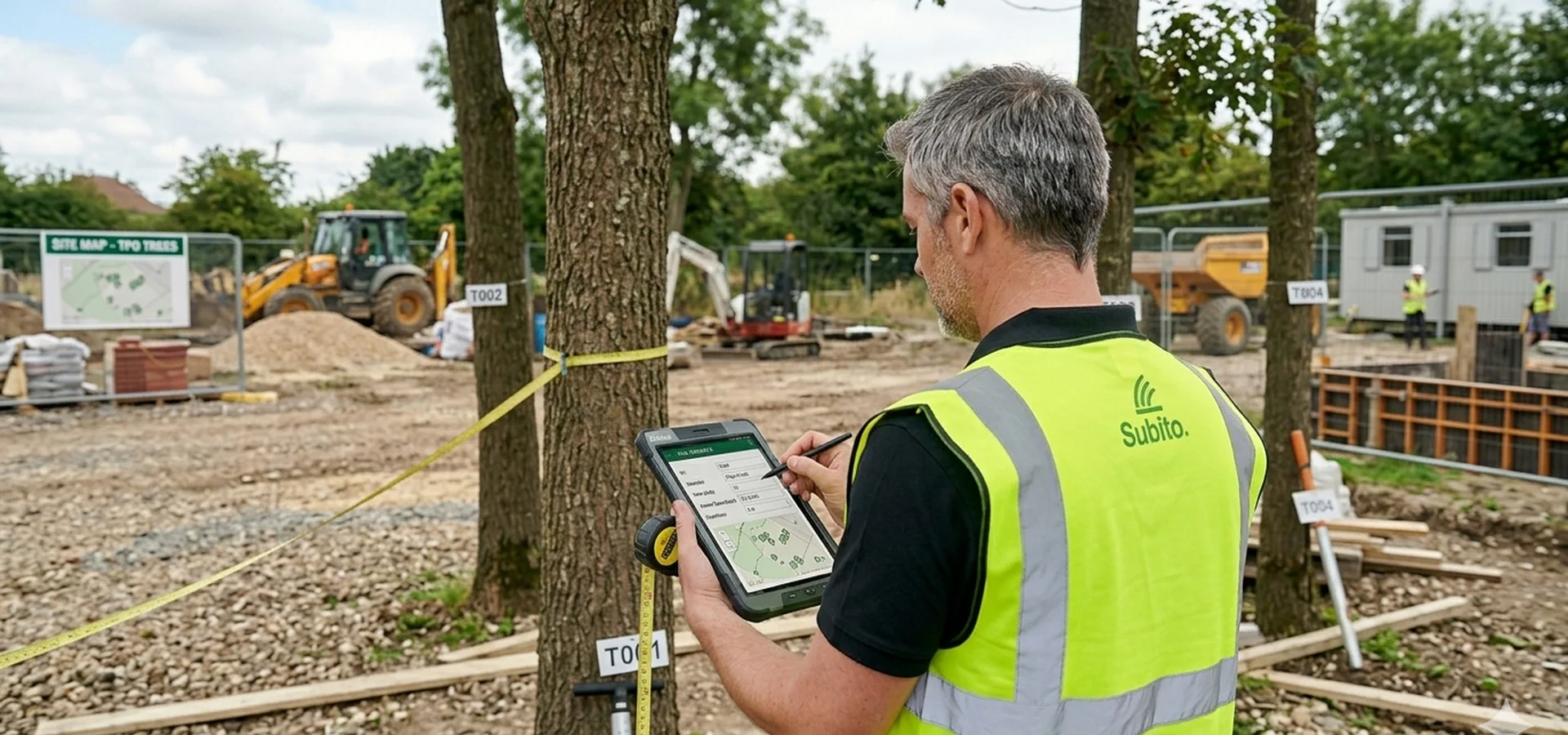
Stage 1: Assessment and planning. Before any work begins on site, a tree survey and assessment establishes tree health, soil conditions, site constraints, the location of underground utilities, and the specific areas to be investigated. This stage confirms that air spading is appropriate and defines the scope of the work.
Stage 2: Soil removal. The air spade operator directs the compressed air lance into the soil around the target area. Soil is progressively loosened and removed, with protective screens used to contain displaced material and manage dust. Roots, pipes, and cables remain completely undisturbed throughout.
Stage 3: Root exposure, investigation, and remediation. With soil cleared, the root system can be visually inspected. The arboricultural consultant assesses root condition, checks for girdling roots, buried root collars, decay, or damage, and identifies the position and extent of structural roots. Where remediation is appropriate, it is carried out at this stage: root pruning, soil amelioration, or the introduction of improved growing media.
Stage 4: Backfill and aftercare. The excavated area is carefully backfilled. Where the opportunity allows, improved material such as compost or biochar is incorporated to benefit long-term root conditions. Mulch, soil conditioners, or other treatments may be applied. Aftercare guidance covering watering, root zone protection, and monitoring is provided where relevant.
Stage 5: Reporting. A written report documents the findings, including root positions, depths, conditions observed, and any remediation carried out. For development projects, the report sets out the implications for foundation and service design and provides the evidence base for agreeing a safe working methodology with the planning authority.
When air spading is used in a development context
The most common reason for commissioning an air spade investigation in a development context is to establish exactly where structural roots are running before foundation or service designs are finalised. Where a proposed building, wall, or underground service route sits close to a Root Protection Area, the design team needs to know whether roots are present in the ground they intend to work in, and if so, at what depth and in what direction.
Without that information, foundation designs have to be based on conservative assumptions, which often means unnecessary over-engineering or an avoidable conflict with the local planning authority’s tree conditions. Air spading replaces the assumption with evidence, allowing the structural engineer and arboricultural consultant to work from a confirmed root map rather than a calculated estimate.
It is also used where construction activity is suspected of having damaged roots, or where ground conditions need to be assessed before agreeing a method of working within a Root Protection Area.
When air spading is used for tree health
Many trees that appear to be declining, lacking vigour, or in poor structural condition are suffering from problems beneath the surface that have nothing to do with the visible crown. Compacted soil is one of the most common causes: heavy pedestrian traffic, vehicle movements, hard surfacing laid over root zones, or construction activity nearby can all reduce the air space in soil to the point where roots can no longer function properly.
Air spading can break up compacted soil around the root zone without root damage, restoring the conditions the tree needs to absorb water and nutrients. When combined with the introduction of improved growing media, composted material, or biochar, the process can reverse decline in trees that would otherwise face removal. It is particularly valuable for veteran trees, urban street trees, and any specimen where retention is a priority but the growing conditions are compromised.
Root collar excavation and buried root problems
One specific application of air spading is the excavation of the root collar: the area where the trunk base meets the soil. Trees are frequently planted too deeply, or have soil and debris accumulate around their base over time, causing the root collar to become buried. This leads to collar rot, girdling roots, and a range of conditions that weaken the tree from the base.
Air spading can carefully clear soil from around the root collar to expose the underlying structure, allow assessment of any decay or damage, and address the conditions causing the problem. In some cases this is the only intervention needed to stabilise a declining tree.
When air spading is not appropriate
Air spading is a valuable tool but it is not right for every situation. Understanding its limitations is as important as knowing its uses.
Very heavy clay soils, compacted subsoils, and rock can resist the compressed air jet, making excavation slow, incomplete, or impractical. In these conditions an alternative approach may be more effective.
Frozen or waterlogged ground is not suitable for air spading. Frozen soil cannot be dislodged effectively, and working in waterlogged conditions creates unnecessary site disruption without reliable results.
Drought conditions require careful consideration. If a tree is already under significant moisture stress, additional soil disturbance around the root zone risks compounding that stress. The timing of any investigation should take current tree condition and recent weather into account.
Ecologically sensitive contexts warrant caution. Air spading disrupts soil strata, including fungal networks and soil organisms that play an important role in tree health and wider ecosystem function. Where an investigation is proposed in or near a sensitive ecological area, the potential impact on soil ecology needs to be weighed against the benefit of the investigation.
Finally, for straightforward situations where roots are healthy, soil conditions are good, and no visible stress is present, air spading may add cost and disturbance without providing proportionate benefit. We will tell you honestly if the work is not warranted.
What happens to the site after the investigation
A concern for some clients is the condition of the site once air spading is complete. In practice the disruption is well managed. Protective boards and screens are used during the operation to contain displaced soil and limit dust. Appropriate safety measures, including eye protection and dust control, are in place throughout.
Once the investigation is finished, the excavated area is backfilled, consolidated gently by hand, and left in a condition suitable for the surface treatment agreed in advance. Where the backfill material is improved with compost or other organic amendments, the site is left in better rooting condition than it was before the work began.
What an air spade investigation report contains
Following the site investigation, we produce a written report documenting the findings. This sets out the location and depth of structural roots identified, the condition of the rooting environment, any root damage or decay observed, and the implications for the proposed development or for ongoing tree management.
Where the investigation was commissioned to inform a foundation or service design, the report is structured to give the structural engineer and planning authority the information they need in a clear and usable format. Where it was commissioned for tree health purposes, the report sets out recommended follow-up treatments and a prognosis for the tree.
What it costs and how to get started
Air spade investigation costs depend on the size of the area to be investigated, the number of trees involved, and the site access conditions. Where the investigation forms part of a broader arboricultural instruction, it can often be programmed efficiently alongside other site visits.
To get a quote, provide us with your site address, a brief description of what you need the investigation to establish, and any existing survey or planning documents relevant to the trees involved. We will confirm scope and provide a fixed price promptly.
Guides & insights
Guides & insights
Practical explainers on BS5837, constraints plans and what planning authorities expect.
More surveys
Looking for a different tree survey?
Browse every survey type and deliverable — constraints plans, impact assessment, protection plans and more — on our tree surveys overview.