From £299
Arboricultural Method Statement (AMS)
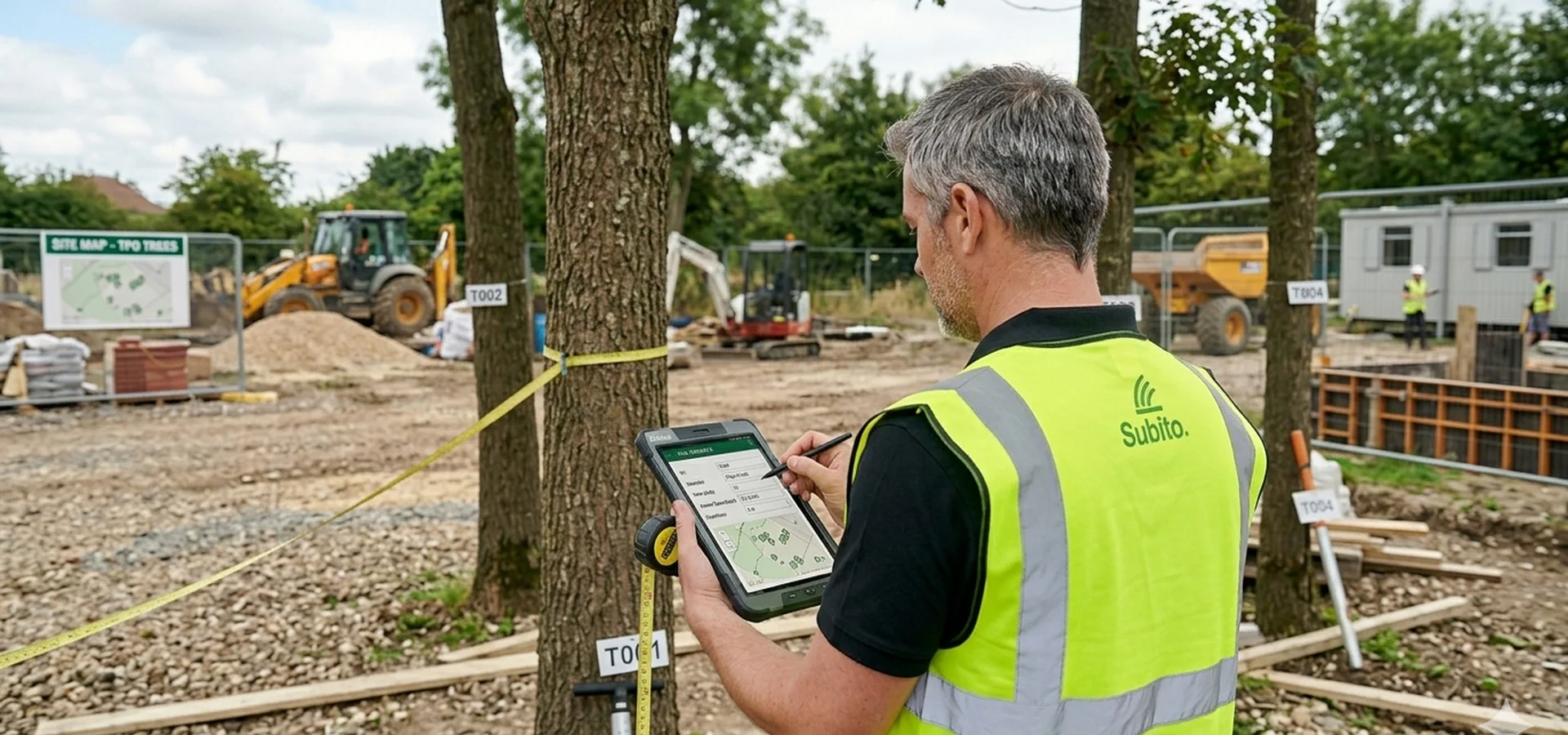
Planning permission is granted on the basis that certain things will happen on site. The AMS is how you prove they will — taking tree survey and AIA findings and turning them into a step-by-step methodology your contractors can follow from day one.
Overview
Putting Planning Conditions Into Practice
Planning permission is granted on the basis that certain things will happen on site. The AMS is how you prove they will. It takes the findings from the tree survey and the Arboricultural Impact Assessment and converts them into a step-by-step working methodology that your contractors can follow from day one.
The document covers where protective barriers must be installed, how operations within or near Root Protection Areas must be carried out, how site access and materials storage must be managed, and who is responsible for monitoring compliance as the build progresses.
Without an approved AMS, pre-commencement conditions on your consent remain unsatisfied and work cannot legally begin. We produce AMS documents quickly and to a standard that planning officers accept, so your programme is not held up once consent lands.
FAQ
Arboricultural Method Statements — Your Questions Answered
What an AMS contains
An AMS is a written document that sets out, in precise and actionable terms, how construction will be managed to protect retained trees throughout the build. It does not summarise the situation — it instructs on it.
The document typically covers the Tree Protection Plan, setting out fencing positions, ground protection requirements, and Construction Exclusion Zones. It addresses any operations proposed within Root Protection Areas and specifies what alternative techniques must be used, such as no-dig methods or trenchless service installation. It also sets out how the site will be managed day to day: where contractors can access, where materials can be stored, and what restricted working areas apply. Arrangements for monitoring and supervision are included, specifying who checks compliance, how often, and how findings are reported.
When your council will require one
An AMS is most commonly required as a pre-commencement condition on a planning consent where trees are being retained and the council wants documented assurance that construction activity will not put them at risk. This is particularly likely on sites with high-category trees, Tree Preservation Orders, or trees within or adjacent to a conservation area.
In some cases the need for an AMS is identified during the AIA process and flagged in that report. In others the local authority specifies it directly in the planning conditions. Either way, it must be submitted and approved before demolition or construction begins.
How the AMS connects to the AIA and TPP
An AMS sits at the end of the arboricultural document chain, not the beginning. It can only be prepared once the AIA has established what the impact of the development will be on each tree and what mitigation is required. The AMS then takes those recommendations and translates them into the specific instructions contractors will work from.
Where a Tree Protection Plan is also required, the AMS and TPP work in parallel: the TPP provides the scaled drawing of protection measures, while the AMS provides the written methodology that supports and explains it. Where we have prepared the AIA, we already hold the site data and can move to the AMS without delay or duplication.
What happens during and after construction
An AMS is not simply a document that satisfies a planning condition and is then filed away. It is a live reference for the site team throughout the build. Protective measures must be installed before any work begins, and the AMS sets out the sequence for doing so.
As construction progresses, the AMS specifies the monitoring arrangements: how frequently the site is inspected, who carries out those inspections, and how any issues are reported to the client and the local planning authority. Where operations close to trees are required, those must be supervised by a qualified arboriculturist in accordance with the AMS. At the end of the build, protective measures are removed only once the risk to trees has passed.
What it costs and how to get started
AMS pricing depends on the complexity of the site, the number of retained trees, and the level of supervision the council has specified. Where we carried out the original BS5837 survey or AIA, we already have the site data and can produce the AMS efficiently. Pricing starts from £299.
To get a fixed quote, provide us with your planning consent and any correspondence setting out the conditions. We’ll confirm what the AMS needs to cover and get a price back to you quickly, with no hidden extras.
Guides & insights
Guides & insights
Practical explainers on BS5837, constraints plans and what planning authorities expect.
More surveys
Looking for a different tree survey?
Browse every survey type and deliverable — constraints plans, impact assessment, protection plans and more — on our tree surveys overview.