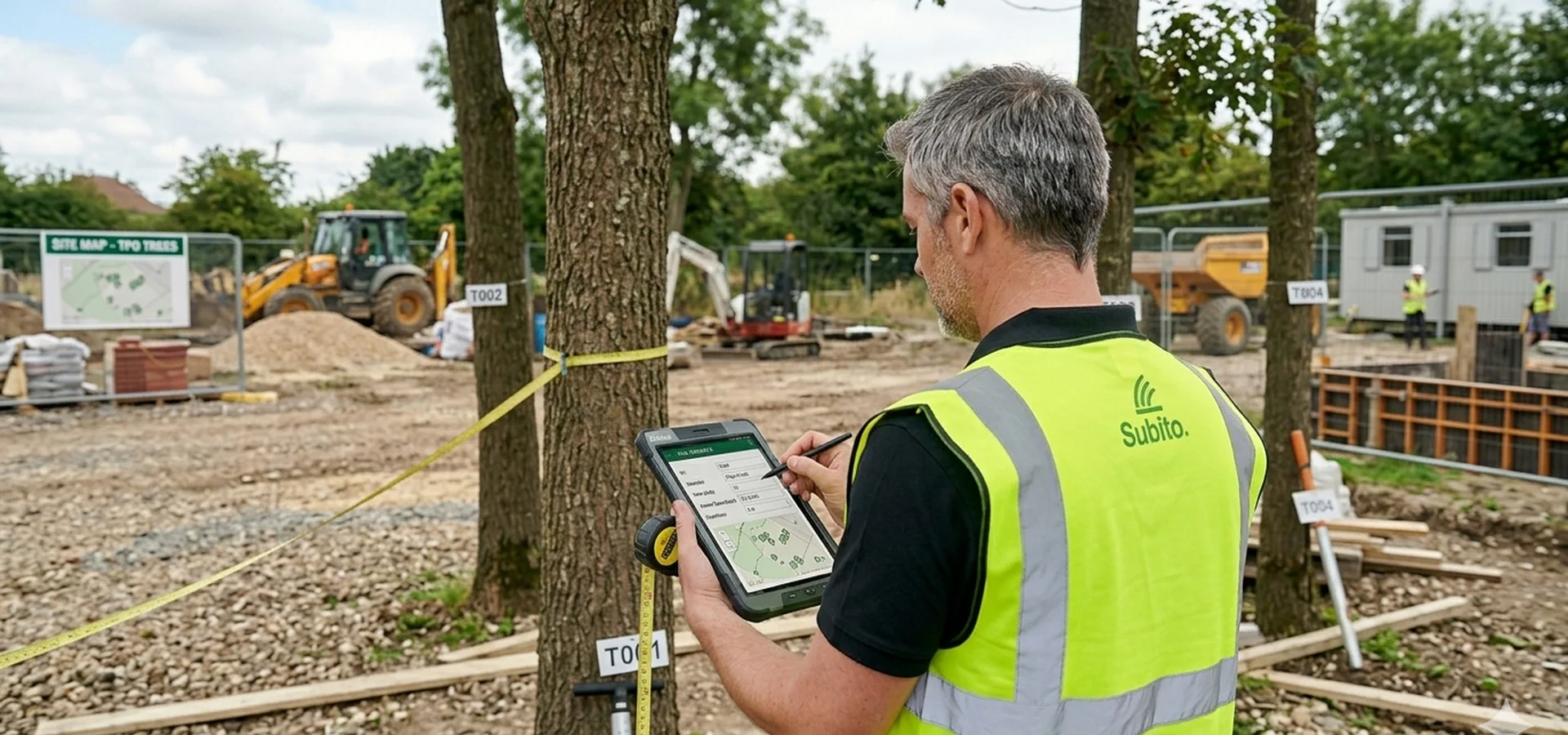
CAVAT Tree Assessment
CAVAT — Capital Asset Value for Amenity Trees — is the recognised UK method for putting a financial figure on the public benefit a tree provides. We produce CAVAT reports to underpin valuations, planning negotiations, compensation claims, and other development decisions.
Overview
Giving Trees a Number That Stands Up
Trees have value that goes beyond their timber or replacement cost. CAVAT provides a way to quantify that value in monetary terms — a figure that reflects the tree’s size, condition, location, visibility, and expected lifespan, set against the number of people who benefit from it.
That figure matters when a planning authority is weighing the loss of a mature tree against a development proposal, when compensation is being sought for a tree that has been damaged or unlawfully removed, or when an organisation needs to account for its tree stock as a managed asset.
CAVAT is used by over half of UK local authorities and is the standard framework for tree valuation in planning, legal, and compensation contexts. Our assessments are produced by trained practitioners using the current methodology and unit value factor, and are written to withstand scrutiny from planning officers, solicitors, and insurers.
FAQ
CAVAT Tree Assessments — Your Questions Answered
What CAVAT is and where it comes from
CAVAT was developed by Chris Neilan and the London Tree Officers Association, in collaboration with Forest Research, and has been in use since 2008. It was designed to give tree managers, planners, and decision-makers a consistent and defensible way to express the value of amenity trees in monetary terms, treating trees as public assets rather than liabilities.
The method was updated in 2023 to address the under-valuation of trees that are heavily managed, such as urban pollards, and is reviewed annually to reflect current nursery replacement costs. The current Unit Value Factor is updated each year by the CAVAT Group and applied to all Full Method assessments.
CAVAT is incorporated into the Joint Mitigation Protocol used in subsidence cases and is a policy requirement for replacement planting assessments under the London Plan. It is recognised by local planning authorities, courts, and insurers across the UK.
The Full Method and the Quick Method: which applies to your situation
CAVAT has two distinct approaches, each suited to different circumstances.
The Full Method is used where precision is required for an individual tree or a small group. It calculates a base value from the trunk area and unit value factor, then applies adjustments for the tree’s functional status, canopy completeness, crown condition, amenity contribution, appropriateness to its setting, and safe life expectancy. It is the correct method for compensation cases, planning negotiations involving specific trees, legal proceedings, and any situation where a single defensible figure is required.
The Quick Method is a strategic tool designed for large tree populations. It uses a simplified set of measurements to express the value of a tree stock as a whole, making it well suited to asset management, budget planning, policy development, and comparing tree values across different community areas. Local authorities and large landowners use it to manage their tree stock as a financial asset register.
When a CAVAT assessment is needed
CAVAT reports arise in four main contexts.
In planning and development, local planning authorities may require a CAVAT valuation where a development proposal affects trees of public amenity value. The figure informs negotiations over whether removal can be justified, what compensatory planting should be required, and how Section 106 contributions should be calculated.
In compensation claims, CAVAT provides a credible, evidence-based value for trees that have been damaged, destroyed, or unlawfully removed. Without a formal valuation, compensation settlements tend to be based on replacement planting cost alone, which significantly undervalues mature amenity trees. A CAVAT report prevents that.
In asset management, councils, housing associations, estate managers, and other organisations use CAVAT to record their tree stock as a financial asset, justify maintenance investment, and demonstrate the value of their tree population to funders and stakeholders.
In legal and insurance contexts, CAVAT figures are used to support proof of value in court proceedings, planning appeals, and insurance claims where the loss of a tree is contested.
Who typically commissions a CAVAT report
CAVAT reports are used by a range of clients, each with different reasons for needing a formal tree valuation.
Developers and planning consultants commission CAVAT assessments where trees are present on or adjacent to a development site and the local planning authority requires a valuation to inform its decision. The figure provides an objective basis for negotiation over mitigation, compensatory planting, and Section 106 contributions.
Local authorities use CAVAT to manage their tree stock as a public asset, compare values across community tree index areas, inform budget allocation, and justify investment in tree planting and maintenance programmes.
Landowners and estate managers use CAVAT reports to establish the value of their tree population as part of an asset register, and to quantify the impact of any proposed works or losses.
Insurers and legal professionals rely on CAVAT valuations in compensation disputes, insurance claims, and court proceedings where the financial loss arising from tree damage or removal needs to be evidenced. A CAVAT report produced by a trained practitioner carries the weight required in those contexts.
Consultants and ecologists working on wider site assessments commission CAVAT reports to integrate tree valuation into environmental impact assessments, biodiversity net gain calculations, and other planning documents where the amenity value of trees needs to be formally recorded.
How the value is calculated
A CAVAT Full Method assessment follows a structured sequence. The starting point is the trunk cross-sectional area, measured at a standard point, multiplied by the current Unit Value Factor to produce a base value. That base value is then adjusted through a series of steps.
The Community Tree Index reflects the density of the population that benefits from the tree — a large tree in a busy urban location is worth more than the same tree in a remote rural setting. Functional value adjustments account for crown completeness and canopy condition. Amenity and appropriateness factors consider the tree’s visual contribution, its suitability to the location, and any veteran or historic significance. Finally, safe life expectancy applies a scaling factor based on how long the tree is expected to remain viable: trees with more than 80 years of safe life expectancy retain their full adjusted value, while those with a short life expectancy are discounted accordingly.
What the report contains
A CAVAT report is structured to give every stakeholder — planning officer, solicitor, insurer, or asset manager — a clear and auditable basis for the valuation figure.
The site inspection section records the measurements, condition assessments, and contextual data gathered during the survey visit. The valuation section sets out the methodology applied, showing how each adjustment was derived so the figure can be interrogated and defended. The output is expressed as a capital asset value in pounds sterling, presented on a survey spreadsheet with a full derivation trail. Where multiple trees are assessed, each receives its own valuation record.
The report concludes with interpretation and recommendations: contextual guidance on what the figure means for the specific planning, legal, or management situation, and what the appropriate next steps are. This section is what turns a valuation number into something the client can act on.
Why the valuation needs to be carried out by a trained practitioner
CAVAT valuations involve professional judgement at several points in the calculation, particularly in assessing functional status, amenity contribution, and life expectancy. Applied inconsistently, those judgements produce figures that cannot be defended under scrutiny.
Our assessments are carried out by arboricultural consultants with specific training in both the Full and Quick methods and experience of producing reports for planning, legal, and compensation purposes. We apply the current unit value factor and follow the published methodology, and our reports are structured to give local authority tree officers, solicitors, and planners the transparency they need to rely on the figures.
What it costs and how to get started
CAVAT assessment pricing depends on the number of trees to be valued and the method required. Full Method assessments for individual trees or small groups are priced per tree. Quick Method assessments for larger populations are priced on the basis of the total number of trees and the site involved.
To get a quote, tell us what you need the valuation for, the number of trees involved, and the site location. We will confirm the appropriate method and provide a fixed price.
Guides & insights
Guides & insights
Practical explainers on BS5837, constraints plans and what planning authorities expect.
More surveys
Looking for a different tree survey?
Browse every survey type and deliverable — constraints plans, impact assessment, protection plans and more — on our tree surveys overview.