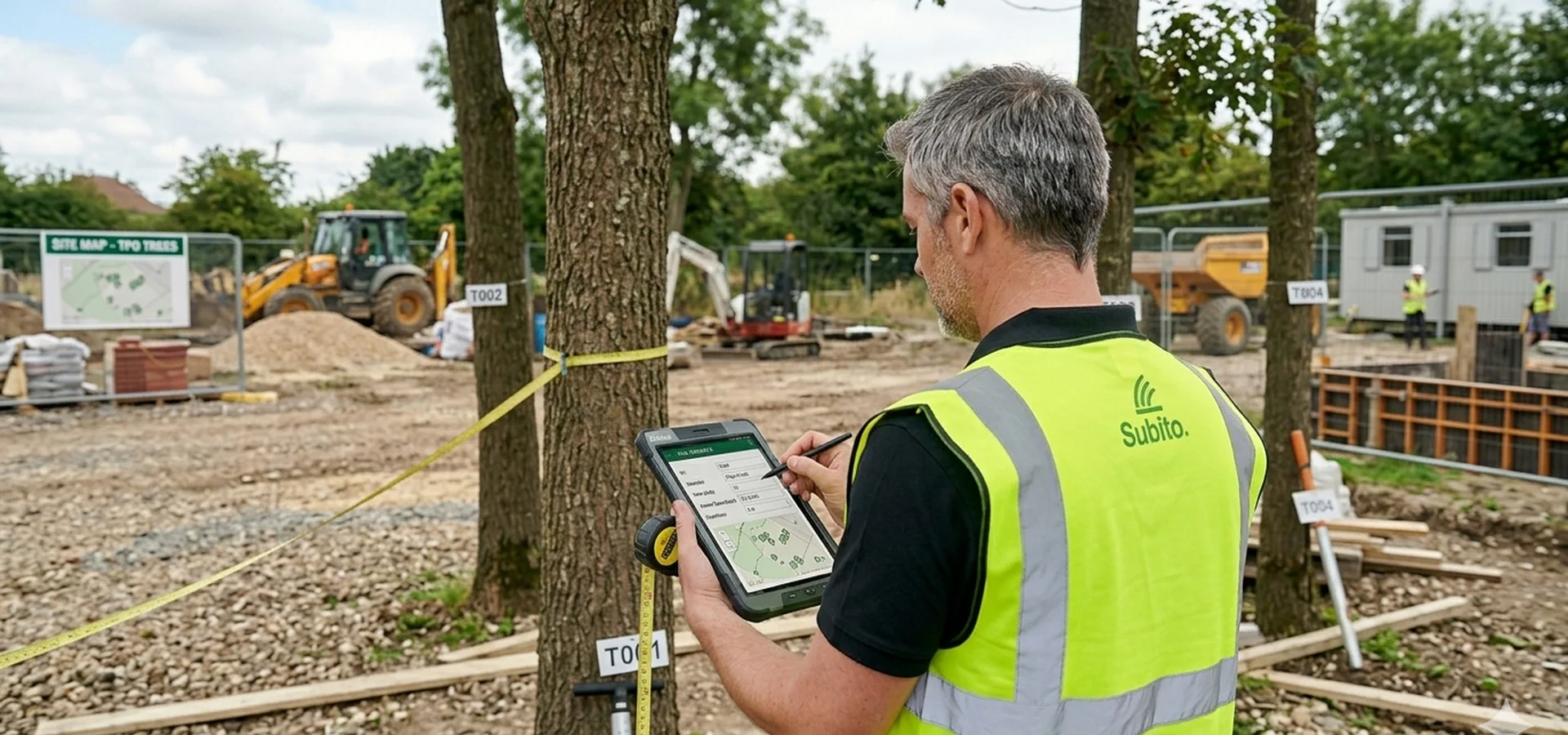
Decompaction Injection
Compacted ground stops water, air, and nutrients reaching the roots. A compressed-air injection breaks up the soil structure safely around the root system, and we can fold in compost, biochar, or other conditioners through the same openings while the soil is loose — restoring the conditions a tree needs to function without excavating a single root.
Overview
Treating the Cause, Not Just the Symptoms
A tree showing signs of stress above ground is often suffering below it. Sparse canopy, early leaf drop, poor vigour, and reduced growth are all classic responses to a root system that cannot breathe. In many cases the cause is compacted soil, and the visible symptoms only appear once the problem has been developing for some time.
Decompaction injection treats the root zone directly. A geo-injector probe is inserted into the soil at measured points across the root zone and high-pressure air is discharged, fracturing compacted layers and opening up the pore space that roots and soil organisms need. Conditioners, organic matter, or bio-stimulants can be introduced through the same probe in the same operation, improving soil structure at depth rather than just at the surface.
We only recommend decompaction injection where a proper arboricultural assessment confirms it will provide measurable benefit. It is a useful tool, but it is not a universal remedy, and we will tell you honestly if a different approach is more appropriate.
FAQ
Decompaction Injection — Your Questions Answered
What decompaction injection is and how it differs from air spading
Both decompaction injection and air spading use compressed air, but they are different tools for different purposes.
Air spading is an excavation technique. The compressed air removes and displaces soil, exposing roots for inspection or clearing space for remediation work. It is the right approach when you need to see what is physically present below ground.
Decompaction injection does not remove soil. A probe is pushed into the ground at defined points and a burst of high-pressure air is discharged within the soil profile, fracturing compacted layers without disturbing the surface or exposing the root system. It is the right approach when the structure of the soil needs to be improved rather than examined.
The two techniques are complementary and can be used together on the same site where both investigation and remediation are required.
Why soil compaction causes serious problems for trees
A healthy soil is roughly half solid material and half pore space filled with air and water. Roots need that pore space to respire, absorb moisture, and access nutrients. When compaction occurs, the pore space collapses and the soil becomes dense and poorly permeable.
The consequences develop gradually. Root respiration declines, nutrient uptake slows, and the soil biome deteriorates as the organisms that support root health lose the conditions they need to function. Above ground, the tree responds with reduced canopy density, smaller leaves, early autumn colour, and general loss of vigour. In severe or prolonged cases, structural roots weaken and the tree becomes vulnerable to pests, disease, and ultimately failure.
Compaction can be caused by surprisingly low levels of activity. A person walking across wet soil exerts enough pressure to cause measurable compaction. Construction vehicles, stored materials, hard surfaces laid over root zones, and years of ordinary foot traffic all contribute to the problem.
How the injection process works
The treatment follows a structured approach, beginning with an arboricultural assessment and ending with aftercare guidance.
Assessment. Before any injection work begins, the site is assessed to confirm that compaction is present, to establish the extent and depth of the problem, and to identify the areas within the root zone where treatment will be most effective. Tree species, age, condition, soil type, and drainage characteristics are all considered. This stage also confirms whether decompaction injection is the right response or whether a different approach is more appropriate.
Targeted injection. The geo-injector probe is inserted into the soil at measured points across the root zone, working from the outer edges of the canopy inward toward the stem. At each point, a controlled burst of high-pressure air is discharged within the soil profile, fracturing the compacted material and restoring pore space. The probe does not cut or damage roots. Treatment depth varies with soil conditions, typically reaching between 30 and 60 centimetres, and deeper in lighter soils.
Soil conditioning. Where the assessment identifies a benefit, conditioners are introduced through the probe immediately after the air injection while the soil is fractured and receptive. These may include organic matter to improve soil structure, biochar to stabilise the improved conditions and support soil biology, mycorrhizal inoculants to restore beneficial fungal networks, or bio-stimulants to support root recovery. The choice of amendment is led by what the soil and the tree actually need.
Surface protection and aftercare. The treated area is typically mulched after injection to protect the improved soil structure and reduce the risk of re-compaction. Guidance is provided on managing access to the root zone, monitoring tree condition, and any follow-up treatment that may be beneficial.
When decompaction injection is most useful
The technique is appropriate in a range of situations, but it is most valuable where the compaction is clearly affecting tree health or has resulted from identifiable changes in how the ground has been used.
On development and construction sites, trees retained within or adjacent to the development footprint are frequently subjected to compaction from vehicle movements, material storage, and temporary access routes. Where compaction has occurred within a Root Protection Area, decompaction injection can form part of the mitigation package agreed with the local planning authority, demonstrating that reasonable steps are being taken to preserve the retained trees.
For trees in decline in urban settings, parks, school grounds, streetscapes, and other high-footfall areas where the cause of stress has been identified as poor soil conditions rather than structural or pest-related problems, decompaction injection addresses the underlying cause rather than managing the symptoms.
Following landscaping or planting works carried out in wet conditions, where compaction has been introduced during establishment, early intervention with injection treatment can prevent the problem from becoming entrenched and support long-term tree performance.
What can be introduced through the injection probe
The ability to introduce amendments through the same probe used for decompaction is one of the most useful aspects of the technique. Rather than simply creating pore space and leaving the soil to recover unaided, the injection operation can deliver improvement directly to where it is needed at depth.
Commonly used amendments include composted organic matter to improve soil structure and provide a food source for soil organisms, biochar to stabilise improved pore structure against future compaction and support the soil biome over the long term, mycorrhizal fungi inoculants to restore the beneficial fungal networks that support root function and nutrient uptake, and phosphite or seaweed-based bio-stimulants to support root recovery and general tree health. The specific combination is selected on the basis of the site assessment rather than applied as a standard formula.
Limitations and when it is not the right approach
Decompaction injection is a useful technique but it is not appropriate in every situation, and it is not a permanent solution without ongoing management.
Where soils are already in reasonable condition and the tree is healthy, treatment is not justified and may cause more disturbance than benefit. Very heavy clay soils, shallow soils, or areas with significant rubble or demolition material beneath the surface can limit the effectiveness of air injection, and in these cases alternative approaches should be considered.
The process does disturb soil structure to some degree, including the fungal networks and soil organisms that contribute to root health. In ecologically sensitive contexts, or around particularly veteran or high-value trees, that disturbance needs to be weighed carefully against the anticipated benefit.
Without aftercare, re-compaction can occur relatively quickly in high-use areas. Decompaction injection should be treated as part of a wider management strategy that includes surface protection and, where possible, a reduction in the activity causing the original compaction. It is not a one-off cure.
How long the benefits last
When decompaction injection is combined with surface mulching and a genuine reduction in the activity that caused the original compaction, the benefits can be long-lasting. The improved pore structure supports root recovery over the months following treatment, and where soil conditioners or biochar have been introduced, the structural improvement tends to persist as those materials resist future compaction better than bare soil.
The honest answer, though, is that longevity depends almost entirely on what happens to the site afterwards. A treated root zone that continues to receive heavy foot traffic or vehicle movements will re-compact, typically within one to three years. A treated root zone that is properly mulched, fenced, or otherwise protected can retain its improved structure indefinitely.
This is why we treat decompaction injection as part of a wider management strategy rather than a standalone fix. The injection addresses the current problem. Aftercare and access management are what determine whether the improvement holds.
Planning compliance and decompaction injection
Where a planning consent includes conditions relating to the protection or management of retained trees, decompaction injection can form part of the documented compliance response. If compaction has occurred within a Root Protection Area during construction, the treatment provides a practical and proportionate remediation measure that can be recorded and submitted as evidence of compliance with the relevant planning conditions.
We can advise on whether decompaction injection is appropriate as a compliance measure for your specific conditions, and produce the supporting documentation the planning authority will need.
What it costs and how to get started
Treatment costs depend on the number of trees, the size of the root zones to be treated, and whether soil amendments are to be introduced. Sites where treatment forms part of a broader arboricultural management programme can often be handled efficiently in a single visit.
To discuss your site, provide us with the location, a brief description of the trees and the conditions affecting them, and any relevant planning documents. We will confirm whether decompaction injection is the right approach and provide a fixed quote for the work.
Guides & insights
Guides & insights
Practical explainers on BS5837, constraints plans and what planning authorities expect.

More surveys
Looking for a different tree survey?
Browse every survey type and deliverable — constraints plans, impact assessment, protection plans and more — on our tree surveys overview.