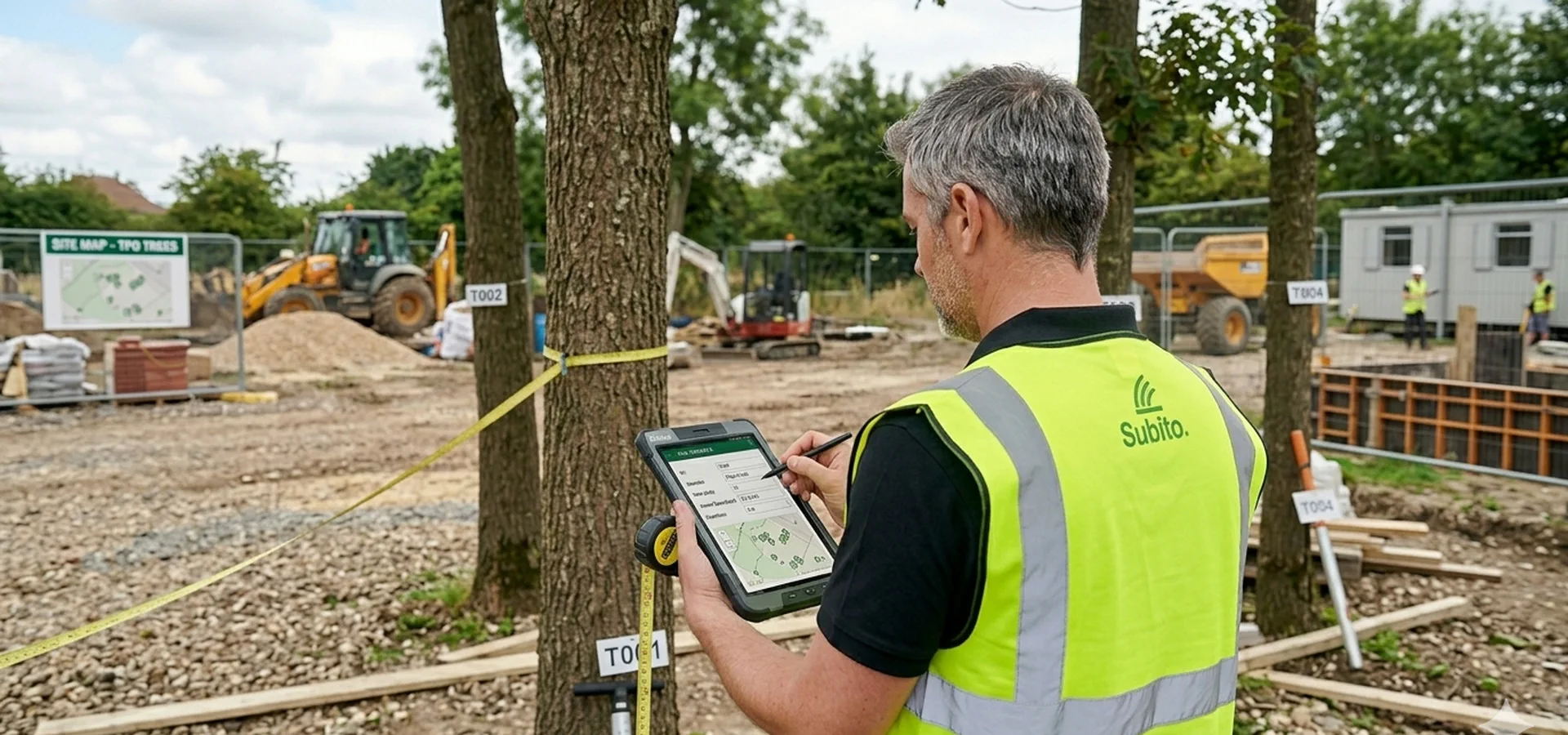
QTRA Tree Risk Assessment
If you own or manage land with trees, you have a legal duty of care to the people around them. A QTRA tree risk assessment puts a number on the risk each tree presents, compares it with nationally recognised thresholds, and gives you a clear, defensible record of what needs to happen and why.
Overview
Managing Tree Risk Without Losing the Trees
Trees bring real value to land and property, but they also carry responsibility. If a tree fails and causes injury or damage, the question any investigation will ask is whether the owner took reasonable steps to identify and manage the risk. A QTRA assessment answers that question with documented evidence.
Unlike planning surveys, which are triggered by development, QTRA assessments are about ongoing land management. They are used by local authorities, housing associations, schools, estate managers, golf courses, and private landowners to show that their trees are inspected proportionately and that risk decisions rest on a sound, measurable basis.
Our arboriculturists are licensed QTRA users. They assess how often people and property are near each tree, how big a part could fail, and how likely it is to fail, then combine the three into a risk of harm for every tree assessed.
FAQ
QTRA Tree Risk Assessments — Your Questions Answered
What QTRA is and why it matters
QTRA (Quantified Tree Risk Assessment) is a tree risk management system that expresses the risk from a tree as a probability of significant harm, for example 1 in 100,000 per year. It applies the same principles of tolerability of risk used by the Health and Safety Executive, so tree risk can be judged on the same footing as other everyday risks.
Because the result is a number rather than a subjective label, decisions are consistent between trees, sites and inspectors. If a decision is ever challenged, the QTRA record shows the inputs, the calculated risk and the reasoning behind each recommendation.
QTRA can only be applied by arboriculturists who have trained with and are licensed by Quantified Tree Risk Assessment Limited. Our assessors hold a current QTRA licence.
Who needs a QTRA assessment
Any person or organisation with a duty of care over trees on their land should have a programme of proportionate tree inspection in place. In practice this includes local authorities managing street and park trees, schools and universities, housing associations and estate managers, golf courses, landed estates, commercial property owners, and private individuals with trees close to paths, roads, or neighbouring properties.
QTRA is particularly useful on large or varied sites, because it directs inspection effort to the places where people and property are actually at risk rather than treating every tree the same.
How the assessment works
A QTRA assessment follows a structured sequence, with effort focused where the risk is.
Target zoning. The site is first divided into zones by how often people, vehicles and property are present: a busy road or playground at one end, a little-used woodland edge at the other. Low-use zones may need little or no individual tree inspection, which keeps the cost of the survey proportionate.
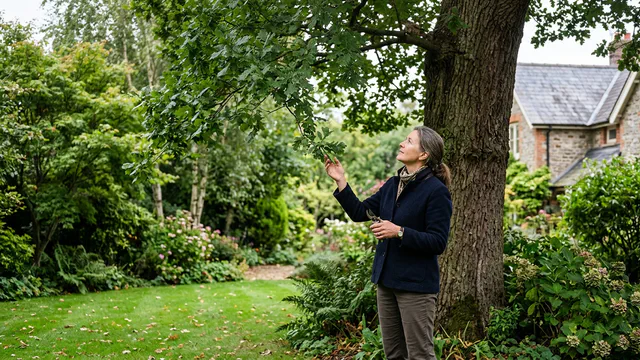
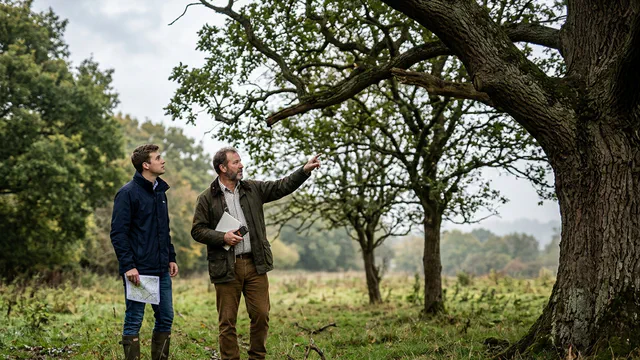
Tree inspection. In zones where it is warranted, the assessor inspects each tree from ground level for structural weakness, decay, deadwood, fungal growth, or damage.
Quantifying the risk. For trees with a potential defect, the assessor estimates three values: the target (how often people or property are within reach of a failure), the size of the part likely to fail, and the probability that it fails within the next year. QTRA combines these into a single risk of harm.
Further investigation. Where internal decay or upper-canopy condition cannot be judged from the ground, additional methods may be recommended, such as sonic tomography, resistograph testing, or an aerial inspection. These are only recommended where the findings warrant them.
Understanding the risk thresholds
Each calculated risk of harm is compared with advisory thresholds based on the HSE’s tolerability of risk framework.
Broadly acceptable (below 1 in 1,000,000). The risk is already as low as most people would accept in daily life. No action beyond routine reinspection.
Tolerable (between 1 in 1,000,000 and 1 in 10,000). The risk is tolerable if reducing it further would cost more, or lose more tree value, than it saves. Works are recommended only where they are reasonably practicable.
Unacceptable (above 1 in 10,000 where the risk falls on others, or 1 in 1,000). The risk should be reduced. Works are planned to an agreed timescale, with the most urgent trees dealt with first.
Weighing the benefits a tree provides against the cost of reducing its risk is central to QTRA. A tree in the tolerable range is not a tree that has been ignored — it is a tree that has been properly assessed and found to present a risk that is as low as reasonably practicable.
What the report contains
The report sets out the target zones, a record for every tree assessed, and a prioritised schedule of works.
For each tree it records the QTRA inputs, the calculated risk of harm and where it sits against the thresholds, any works required to reduce the risk, whether further investigation is needed and why, and the recommended reinspection date. The complete record is what you submit to your insurer, your local authority, or your own governance process as evidence that your duty of care is being properly discharged.
What happens if a tree is identified as high risk
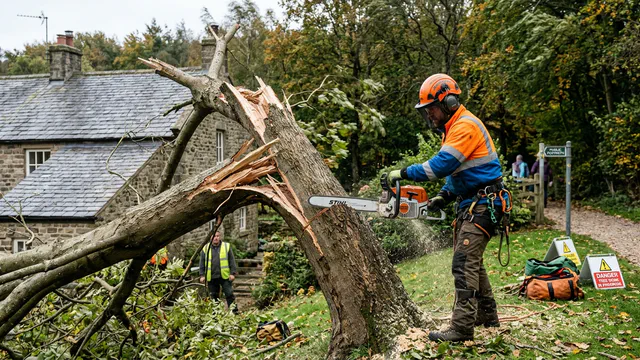
An unacceptable risk does not automatically mean a tree needs to come down. QTRA weighs risk against the tree’s benefits, and the recommendations it produces are proportionate. In many cases targeted works such as crown reduction, removal of deadwood, bracing, or managing access beneath the tree will bring the risk back to a tolerable level while keeping the tree.
Where removal is the only appropriate course of action, the assessment provides the documented justification for it. If the tree is subject to a Tree Preservation Order or sits within a conservation area, we can advise on the application required and support you through that process.
How often assessments should be repeated
Tree risk management is not a one-off exercise. Trees change over time, and the use of a site can shift as paths, buildings and activities change. Each QTRA assessment sets out a recommended reinspection interval for every zone and tree assessed, giving you a clear programme to work to.
For most well-managed sites, inspections on a one to three year cycle are typical. High-use zones, or trees with known defects, may warrant more frequent attention. We can help you build a practical inspection schedule that keeps your duty of care current without creating unnecessary cost.
What it costs and how to get started
QTRA assessment pricing depends on the number of trees to be inspected and the size and location of the site. Target zoning often reduces the number of trees that need individual assessment. For large tree populations, we can discuss a programme approach that spreads the work and the cost over an agreed cycle.
To get a quote, provide us with your site address and an estimate of the number of trees you need assessed. We’ll confirm the scope and get a fixed price back to you promptly.
Guides & insights
Guides & insights
Practical explainers on BS5837, constraints plans and what planning authorities expect.
More surveys
Looking for a different tree survey?
Browse every survey type and deliverable — constraints plans, impact assessment, protection plans and more — on our tree surveys overview.