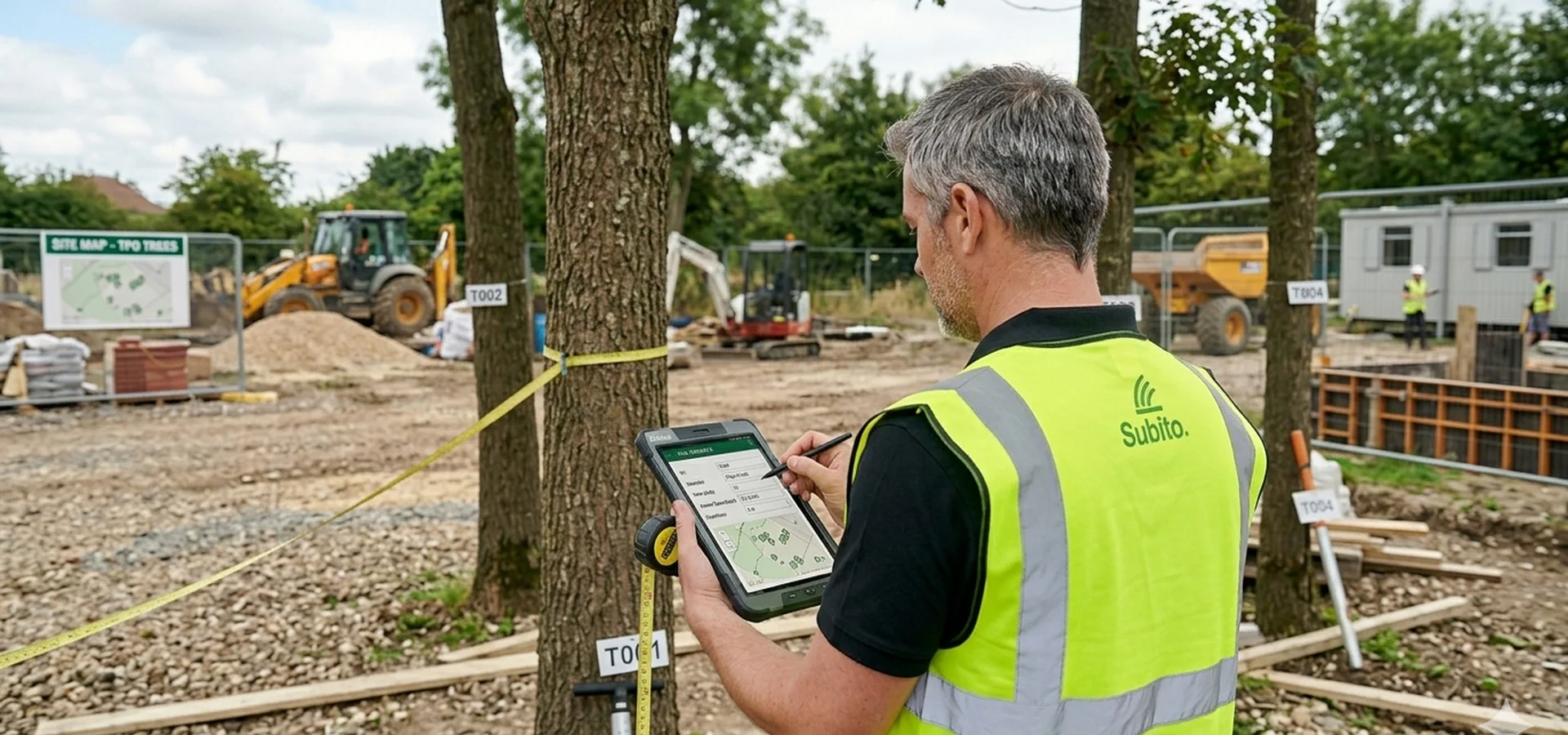
After planning consent
Tree Protection Plan (TPP)
A TPP is usually the last document required before you can legally break ground. It turns your BS5837 survey and impact assessment into practical instructions your contractors can follow and your planning authority can approve.
Overview
The Final Step Before Work Can Start
A TPP is usually the last document required before you can legally break ground. It takes everything established during the BS5837 survey and the Arboricultural Impact Assessment and translates it into a practical set of instructions your contractors can follow from day one.
Every retained tree is accounted for. Fencing positions are mapped, Construction Exclusion Zones are defined, and any permitted activities within Root Protection Areas are set out clearly. Where the TPP connects to an Arboricultural Method Statement, it pulls all of that guidance into a single, coherent framework that your local authority can inspect and your site team can act on.
We produce TPPs quickly after consent is granted so your build programme is not held up waiting for paperwork.
FAQ
Tree Protection Plans — Your Questions Answered
What a Tree Protection Plan contains
A TPP combines a scaled site drawing with a written specification. The drawing plots every tree protection measure precisely onto your site layout: temporary fencing lines, Construction Exclusion Zones (CEZs), areas of temporary ground protection where vehicles must cross Root Protection Areas, and any zones where material storage or construction activity is restricted.
The written element supports the drawing by setting out how each measure must be installed, what contractors must avoid, and what steps are required if protective barriers need to be temporarily moved during construction. Together, they leave nothing to interpretation on site.
Where an Arboricultural Method Statement is also required, the TPP links directly to it, ensuring that site-specific guidance for sensitive operations is captured in one place.
Why a TPP is a legal requirement
When planning permission is granted for a development where trees are being retained, the local authority attaches conditions to ensure those trees survive the build. A TPP is the standard mechanism for satisfying those conditions before any work begins on site.
Starting construction without a signed-off TPP is a breach of your planning conditions. If retained trees are subsequently damaged, the consequences can include enforcement action, financial penalties, and a requirement to carry out compensatory planting at your cost. A properly prepared TPP removes that risk entirely.
How the plan is put together
Creating a TPP follows a clear sequence, beginning with the data collected during the BS5837 tree survey and working through to a finished document ready for council submission.
First, survey data covering the condition, size, and species of every retained tree is used as the foundation. Protection measures are then plotted directly onto the site plan, with Root Protection Areas checked against the proposed development layout to identify any conflicts. Necessary measures are specified, including fencing type and position, ground protection solutions, and CEZ boundaries. Where required, a supporting Arboricultural Method Statement provides written guidance for sensitive operations. The finished plan is delivered as both a PDF and a CAD drawing for submission to your local planning authority.
How fencing positions and exclusion zones are determined
Protection measures are designed around the Root Protection Area of each retained tree, calculated from the BS5837 survey data. Fencing is positioned to keep construction activity, ground compaction, and materials storage clear of the root zone throughout the build.
Where site constraints mean that some activity within a Root Protection Area cannot be avoided, the TPP specifies what is permissible and under what conditions, including any ground protection measures such as no-dig surfaces or load-spreading matting that must be in place first. Nothing is left to the contractor’s discretion.
When to commission a TPP
A TPP is produced after planning consent has been granted, not before. It sits downstream of the BS5837 tree survey and, where one was required, the Arboricultural Impact Assessment.
Timing matters. Most planning consents require the TPP to be approved by the local authority before demolition or construction begins. Leaving it until work is ready to start risks a delay while the council reviews and approves the document. Commission the TPP as soon as consent lands so it is ready before your contractor mobilises.
What it costs and how to get started
TPP pricing depends on the number of retained trees, the complexity of the site, and whether a BS5837 survey has already been completed. Where we carried out the original survey, we already hold the site data and can produce the TPP efficiently.
Request a quote with your planning consent reference and site address. We’ll confirm what’s needed and get a fixed price back to you promptly. No hidden costs, no open-ended fees.
Guides & insights
Guides & insights
Practical explainers on BS5837, constraints plans and what planning authorities expect.
More surveys
Looking for a different tree survey?
Browse every survey type and deliverable — constraints plans, impact assessment, protection plans and more — on our tree surveys overview.