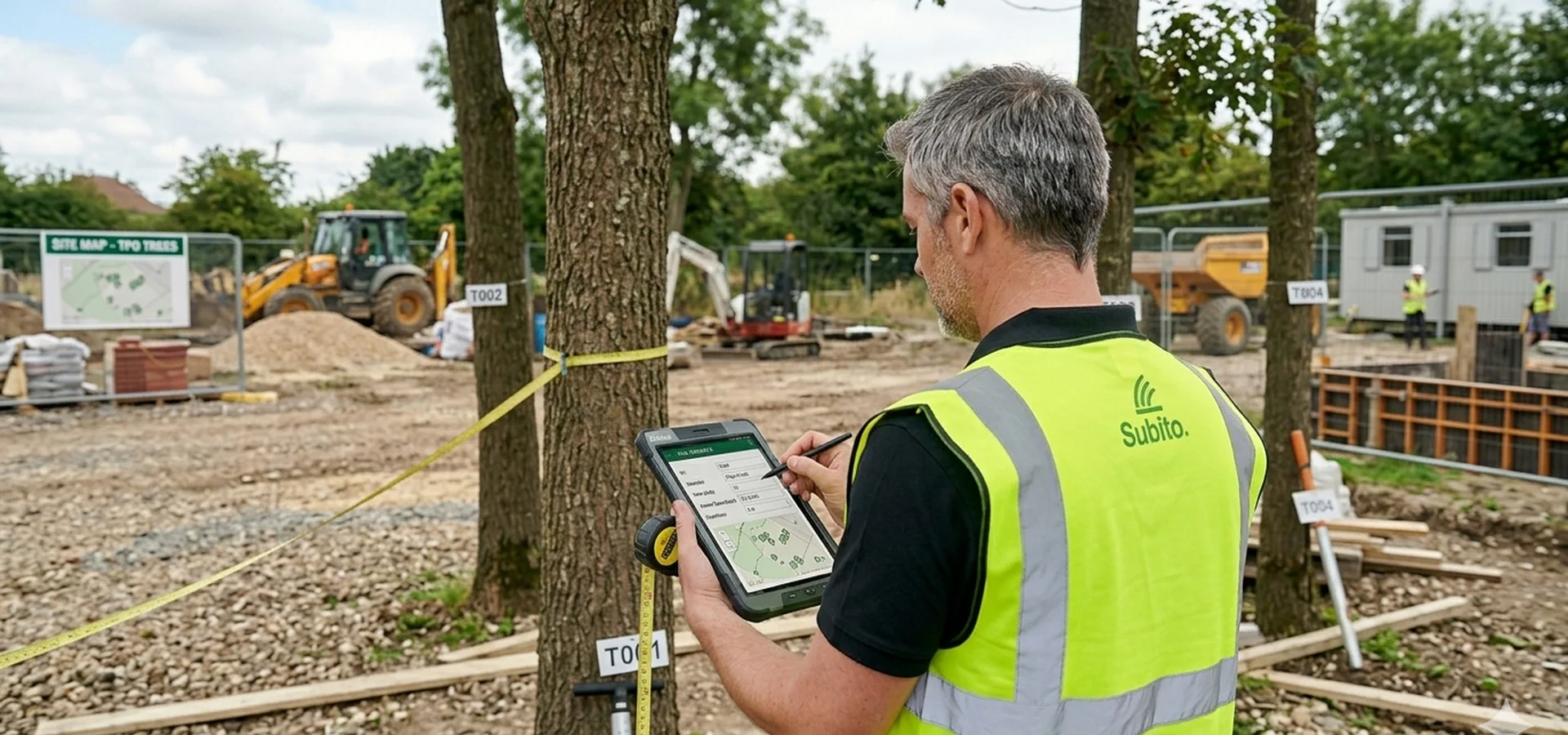
VALID Tree Risk Management
If you own or manage land with trees, you have a legal duty of care to the people around them. VALID tree risk assessments give you a clear, proportionate, and defensible record of every decision made about your tree stock — what risk each tree presents, what action is required, and the reasoning behind it.
Overview
Managing Tree Risk Without Losing the Trees
Trees bring real value to land and property, but they also carry responsibility. If a tree fails and causes injury or damage, the question any investigation will ask is whether the owner took reasonable steps to identify and manage the risk. A VALID assessment answers that question with documented evidence.
Unlike planning surveys, which are triggered by development, VALID assessments are about ongoing land management. They are used by local authorities, housing associations, schools, estate managers, golf courses, and private landowners to demonstrate that their trees are being inspected regularly and that risk decisions are being made on a sound, proportionate basis.
Our arboriculturists are trained as Validators and use the VALID framework to assess each tree against established risk and benefit criteria. The result is a clear record for every tree assessed — what was found, what it means, and what needs to happen next.
FAQ
VALID Tree Risk Assessments — Your Questions Answered
What VALID is and why it matters
VALID is a tree risk-benefit management system built around the Health and Safety Executive’s Tolerability of Risk framework and ISO 31000 Risk Management Standards. It was developed to give tree owners and managers a structured, consistent, and legally recognised basis for making decisions about their trees.
What sets VALID apart from less formal inspection approaches is that it is explicitly designed to be defensible. Every assessment is documented in a way that demonstrates the reasoning behind each decision, whether that is to leave a tree as it is, carry out remedial works, or recommend removal. If a decision is ever challenged, the VALID record shows it was reached through a proper, evidence-based process.
Arboriculturists trained and certified in the VALID system are known as Validators. Only a qualified Validator can produce a VALID assessment.
Who needs a VALID assessment
Any person or organisation with a duty of care over trees on their land should have a programme of regular tree inspection in place. In practice this includes local authorities managing street and park trees, schools and universities with trees on their grounds, housing associations and estate managers, golf courses, National Trust-type landowners, commercial property owners, and private individuals with trees close to paths, roads, or neighbouring properties.
The frequency of inspection depends on the risk profile of the trees and the site. A tree in a busy urban park warrants more regular inspection than one in a remote rural setting. A VALID assessment will set out a recommended reinspection interval for each tree based on what was found.
How the assessment works: the four-stage process
A VALID assessment follows a structured sequence, with the level of investigation determined by what is found at each stage.
Stage 1: Basic Assessment. The Validator begins with a ground-level visual inspection of every tree in scope, looking for obvious signs of structural weakness, decay, deadwood, fungal growth, or damage. Trees that show no cause for concern are recorded and assigned a reinspection interval. Those showing potential risk features are carried forward to Stage 2.
Stage 2: Detailed Risk Assessment. For trees where concerns were identified, the Validator conducts a more thorough assessment considering three factors: the likelihood that the tree or a part of it will fail; the likelihood that a person or asset will be in the impact zone when failure occurs; and the consequences if failure does happen. Together these factors determine the level of risk the tree presents.
Stage 3: Risk Categorisation. Findings are categorised using the VALID traffic light system, producing a clear rating for each tree that tells the duty holder what action, if any, is required.
Stage 4: Advanced Assessment. Where a tree presents complex or uncertain risks that visual inspection cannot fully resolve, additional diagnostic methods may be recommended. These include sonic tomography to assess internal decay not visible from the outside, resistograph testing to detect hollow sections within the trunk, or an aerial inspection for trees where upper-canopy condition is a concern. Advanced assessment is not required for every tree — only where the findings of Stages 1 to 3 warrant it.
Understanding the traffic light ratings
Every tree assessed receives one of four ratings, each with a clear implication for the duty holder.
Red: Not Acceptable. The risk presented by this tree requires immediate action. Works to reduce the risk to an acceptable level must be carried out as a priority.
Amber: Not Tolerable. The risk requires action, but with lower urgency than a Red rating. Works should be planned and carried out within an agreed timescale.
Amber: Tolerable. The risk does not require immediate action but should be monitored. More frequent reinspection may be appropriate.
Green: Acceptable. The risk is within acceptable limits. No action is required beyond routine monitoring at the recommended interval.
The traffic light system is designed to produce proportionate outcomes. A tree rated Amber or Green is not a tree that has been ignored — it is a tree that has been properly assessed and found to present a manageable level of risk. That distinction matters if a decision is ever questioned.
What the report contains
At the end of the assessment, every tree receives a one-page summary setting out its risk rating, the basis for that rating, and the recommended next steps. The full report collates these summaries into a complete inspection register covering your entire tree population.
For each tree the report records the risk rating from the traffic light system, the recommended reinspection date, any specific works required to reduce risk, whether advanced assessment is needed and why, and any broader management observations relevant to the tree’s long-term condition. The complete record is what you submit to your insurer, your local authority, or your own governance process as evidence that your duty of care is being properly discharged.
VALID and QTRA: what is the difference
Both VALID and QTRA (Quantified Tree Risk Assessment) are used to evaluate the risk presented by trees, and both are recognised by planning authorities and insurers. The key difference is in their approach.
VALID is a qualitative system based on visual observation and professional judgement, structured within the HSE’s Tolerability of Risk framework. It is well suited to regular inspection programmes covering large tree populations, and produces results that are clear and accessible to non-specialist stakeholders.
QTRA is a quantitative system that assigns numerical probabilities to failure risk. It is more complex to apply and is typically used where a very high degree of precision is required — for example where a high-category tree is the subject of a disputed decision or a legal process.
For most ongoing tree management programmes, VALID is the appropriate framework. If your situation requires a QTRA or you are unsure which applies, we can advise.
What happens if a tree is identified as high risk
A Red or Amber rating does not automatically mean a tree needs to come down. VALID is a risk-benefit framework, and the recommendations it produces are proportionate to what was found. In many cases, targeted remedial works such as crown reduction, removal of deadwood, bracing, or installation of a support system will reduce the risk to an acceptable level while retaining the tree.
Where removal is the only appropriate course of action, the assessment provides the documented justification for it. If the tree is subject to a Tree Preservation Order or sits within a conservation area, we can advise on the application required and support you through that process.
How often assessments should be repeated
Tree risk management is not a one-off exercise. Trees change over time, and the risk profile of a site can shift as use patterns, surrounding structures, and tree condition evolve. Each VALID assessment sets out a recommended reinspection interval for every tree assessed, giving you a clear programme to work to.
For most well-managed sites, inspections on a one to three year cycle are typical. Higher-risk trees, or those in high-footfall locations, may warrant more frequent attention. We can help you build a practical inspection schedule that keeps your duty of care current without creating unnecessary cost.
What it costs and how to get started
VALID assessment pricing depends on the number of trees to be inspected and the size and location of the site. For large tree populations, we can discuss a programme approach that spreads the work and the cost over an agreed cycle.
To get a quote, provide us with your site address and an estimate of the number of trees you need assessed. We’ll confirm the scope and get a fixed price back to you promptly.
Guides & insights
Guides & insights
Practical explainers on BS5837, constraints plans and what planning authorities expect.

More surveys
Looking for a different tree survey?
Browse every survey type and deliverable — constraints plans, impact assessment, protection plans and more — on our tree surveys overview.